
FoodExpoConnect Blog
Best CRM for Food Export Businesses 2026: Pipedrive vs HubSpot vs Spreadsheets
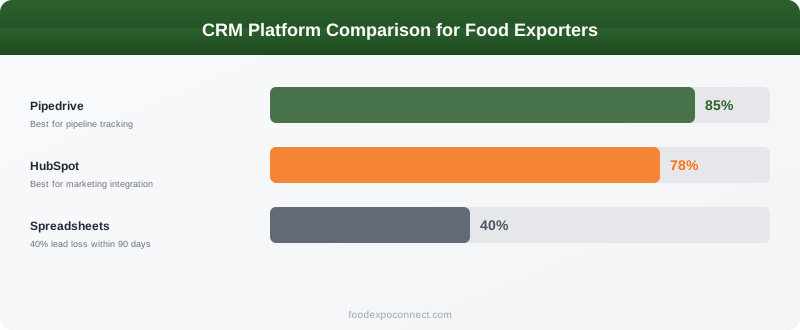
Most food exporters track buyers in spreadsheets and lose 40% of follow-ups within 90 days. We tested Pipedrive and HubSpot with real export workflows — here's which CRM actually works for food trade, and when spreadsheets are still the right answer.
Introduction
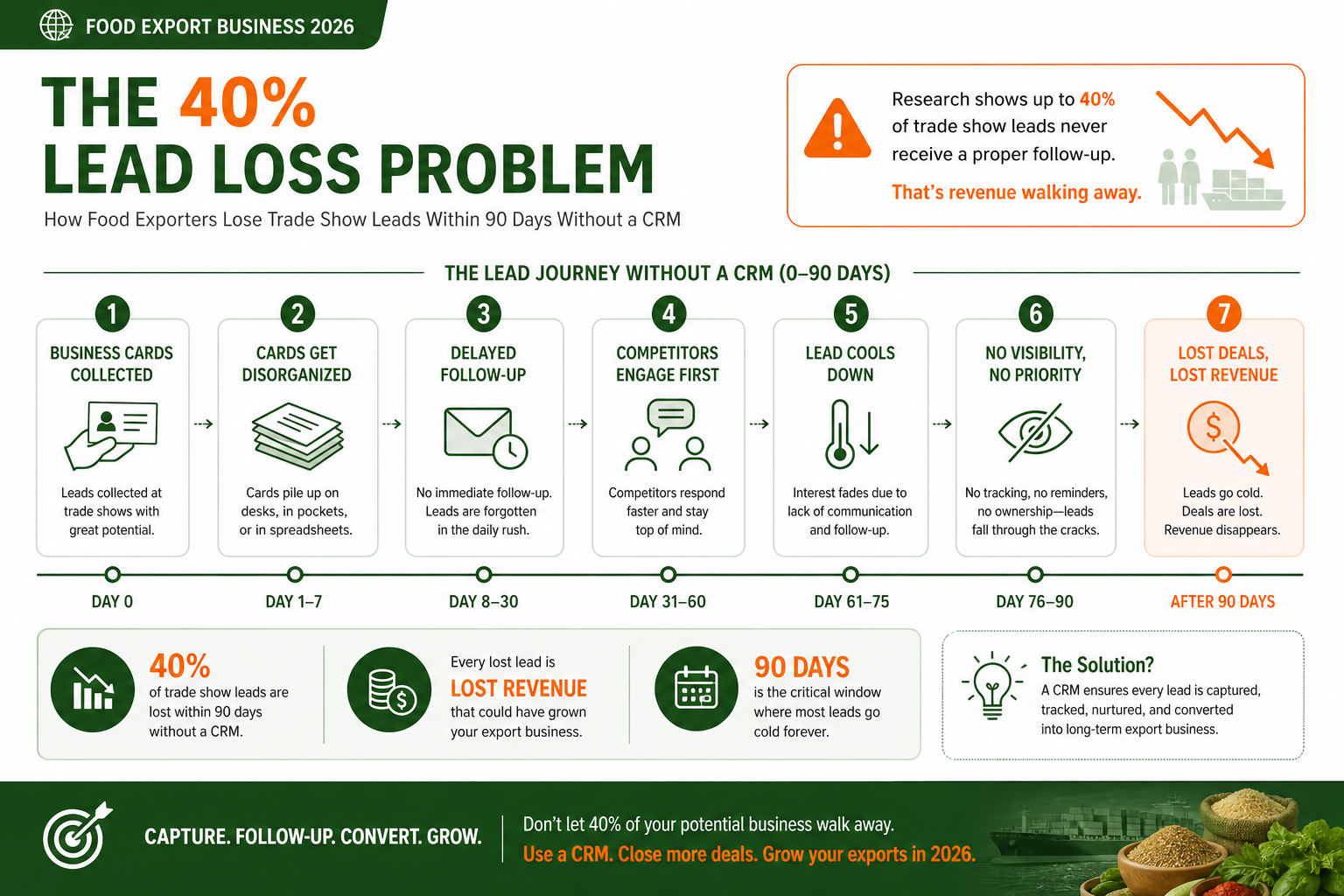
Here's a number that should make you check your spreadsheet: food exporters lose approximately 40% of trade show leads within 90 days without a structured follow-up system. Not because the leads are bad. Because they fall through the cracks.
You come back from SIAL or Anuga with 200 business cards. You send 50 emails in the first week. Then 30 the next. Then life happens — a shipment delay, a certification audit, a supplier negotiation — and the remaining 120 contacts sit in a drawer. Six months later, you find them and think "I should have followed up on these." But by then, they've already signed with your competitor.
A CRM isn't about software. It's about never losing a deal to forgetfulness again.
But which CRM actually works for food export? Most CRM content online is written for SaaS companies selling software subscriptions, not for businesses shipping physical products across borders with complex documentation, multi-currency payments, and 60-90 day sales cycles.
I tested Pipedrive and HubSpot against real food export workflows. Here's the comparison that actually matters.
The Real Problem: Why Spreadsheets Fail
Before we compare CRMs, let's be honest about what breaks with spreadsheets:
No reminders. A spreadsheet doesn't tell you "it's been 14 days since you emailed this buyer — follow up now." The best exporters build elaborate colour-coding systems and calendar reminders. But when you're juggling 80 active buyer conversations, manual tracking fails.
No activity history. When a buyer replies to your email three weeks later, can you instantly see your entire conversation history? In a spreadsheet, you scroll through a "Notes" column hoping you wrote something useful. In a CRM, every email, call, and meeting is auto-logged against the contact.
No pipeline visibility. How many deals are in negotiation right now? What's their total value? Which ones are stuck and need intervention? A spreadsheet can answer this if you update it religiously. Most exporters don't. A CRM answers it automatically.
Single player. If you're the only person managing buyer relationships, a spreadsheet works — barely. If you have even one other person (co-founder, sales agent, assistant), a spreadsheet creates chaos. Who contacted which buyer last? What was promised?
Pipedrive: Best for Pure Sales Pipeline
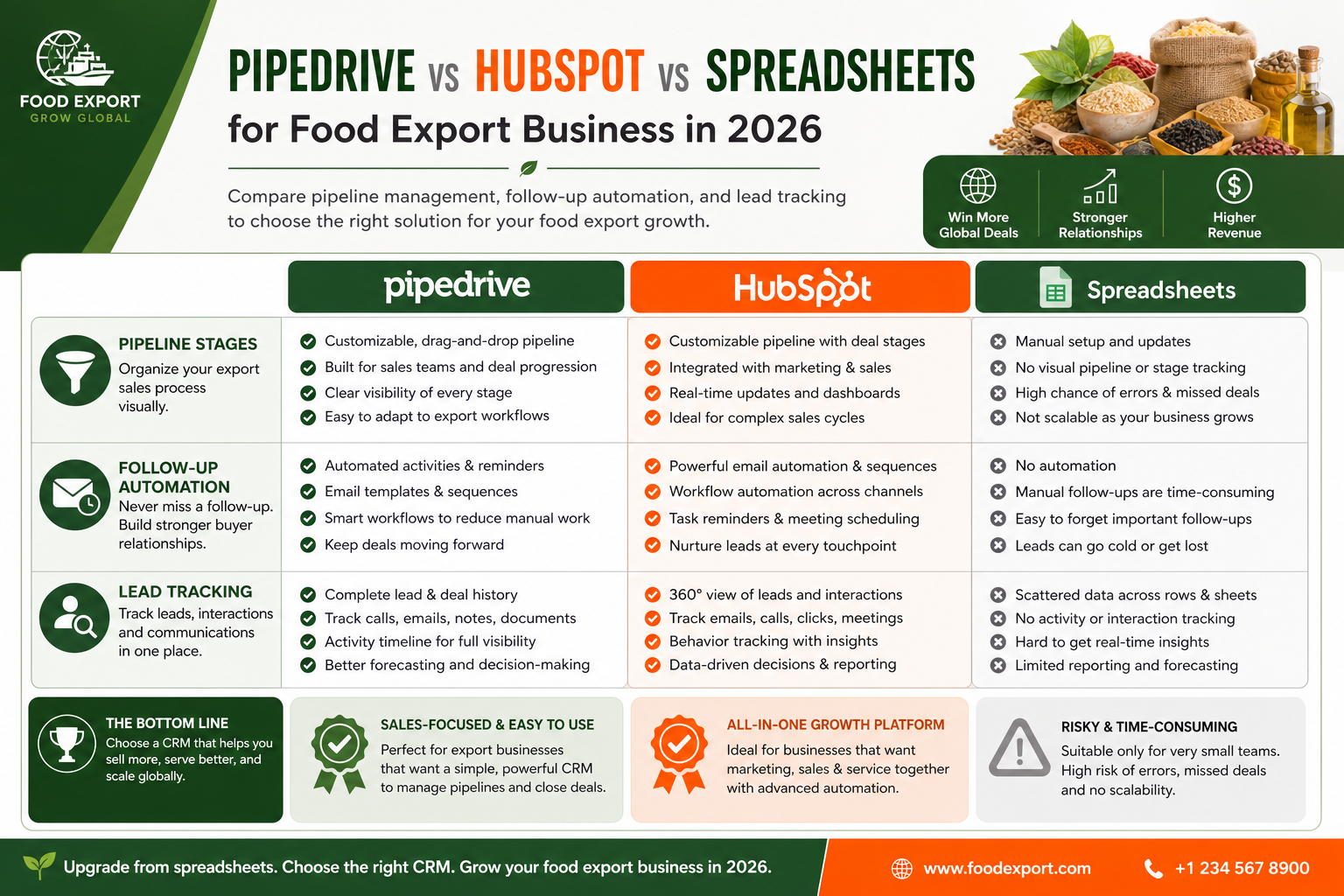
Pipedrive is built for one thing: moving deals through a pipeline. If your primary need is tracking buyers from "first contact" through "negotiation" to "closed deal," Pipedrive is the strongest option.
What it does well for food exporters:
- Visual pipeline that shows exactly where each deal is (no configuration needed)
- Custom fields for export-specific data: Incoterms, payment terms, shipping method, HS codes
- Email sync — connect your Gmail/Outlook and all buyer communication auto-logs
- Activity reminders — "follow up with this buyer in 7 days" — the feature that replaces your memory
- Mobile app that works at trade shows (scan business cards, add contacts on the spot)
What it doesn't do: Marketing. No email campaigns, no landing pages, no blog. Pipedrive is a sales tool, not a marketing platform. If you want to send newsletters or nurture sequences to your buyer list, you'll need a separate tool (or HubSpot).
Cost: Starts at $14/user/month (Essential). The Advanced plan at $34/user/month adds email tracking and group emailing — worth it if you're sending 50+ buyer emails per week.
→ Try Pipedrive free for 14 days (affiliate link — FoodExpoConnect may earn a commission)
HubSpot: Best for Sales + Marketing Together
HubSpot is an all-in-one platform — CRM, email marketing, landing pages, live chat, and content management all in one place. It's more than most food exporters need on day one, but it's the best foundation if you plan to scale content marketing alongside sales.
What it does well for food exporters:
- Free CRM tier that's genuinely useful (unlimited users, up to 1 million contacts)
- Email tracking and templates in the free tier (see when buyers open your emails)
- Built-in email marketing — send newsletters to segmented buyer lists without a separate tool
- Landing page builder — create lead magnet download pages without a developer
- Company insights — automatically pulls company data (industry, size, revenue) on your contacts
What it doesn't do well: Simplicity. HubSpot has more features than you need, and the interface reflects that. Setting up a simple sales pipeline takes longer than in Pipedrive. The platform is designed for companies that want CRM + marketing + service in one ecosystem — if you only need the CRM part, you're carrying complexity you won't use.
Cost: Free CRM tier is genuinely usable. Starter CRM at $45/month adds deal pipelines, simple automation, and meeting scheduling. Marketing Hub starts at $20/month.
→ Start HubSpot free CRM (affiliate link)
The Decision Framework
| If you... | Choose |
|---|---|
| Have 1-5 people, focused purely on managing buyer relationships | Pipedrive |
| Want CRM + email marketing + landing pages in one platform | HubSpot |
| Have zero budget and need basic contact management | HubSpot Free |
| Attend 3+ trade shows/year and need mobile lead capture | Pipedrive (better mobile app for this) |
| Plan to build a content-driven lead gen engine in the next 12 months | HubSpot (marketing integration is the differentiator) |
| Just want the fastest possible setup with minimal learning curve | Pipedrive |
When Spreadsheets Are Still the Right Answer
If you have fewer than 20 active buyer relationships and don't attend trade shows, a well-structured spreadsheet is fine. The overhead of learning and maintaining a CRM isn't worth it at that scale.
But add a "Next Follow-Up Date" column and actually use it. The moment you miss a follow-up, you've outgrown the spreadsheet — even if you don't feel like you have.
📋 Download the CRM Buyer's Checklist →
17-point evaluation checklist for choosing a CRM for your food export business. Includes integration requirements, multi-currency support, pipeline stage templates, and budget guidelines.
Free download — no email required.
The One Thing That Matters Most
CRMs succeed or fail based on one thing: whether you actually use them. The best CRM is the one you'll open every day. For most food exporters I work with, that's Pipedrive — it's faster, simpler, and feels more like a to-do list for your deals than a software platform you have to learn.
Try the free trial. Import 20 contacts. Set three follow-up reminders. If you're still using it after two weeks, it's already paid for itself.
Affiliate disclosure: FoodExpoConnect may earn a commission when you sign up for Pipedrive or HubSpot through links in this article. This does not affect your price.
Frequently asked questions
Do food exporters really need a CRM?
Pipedrive or HubSpot — which is better for a small food export business?
How much does a CRM cost for a small export business?
Can I import my existing spreadsheet of buyers into a CRM?
How do I track trade show leads in a CRM?
Quick facts
Published: 5/17/2026
Reading time: 12 min
Pillars: CRM, Sales
Written by

Jean Marc Koffi
Co-authorJournalist & Export SpecialistLondon
Jean Marc Koffi is an MBA-trained trade specialist who connects African exporters to global buyers, with over $20M in contracts facilitated and expertise recognized by major trade organizations. Noted for rapid buyer network building, he is an experienced speaker and certified in trade facilitation, origin rules, and food safety.

Alocha Massamba
Co-authorFounder, Epifresh & FoodExpoConnectLondon
Alocha Massamba is the founder of Epifresh and FoodExpoConnect. He builds the technology, data and partnerships that connect African food producers and exporters to international buyers — with a focus on fresh-produce supply chains, cold-chain logistics, and the buyer-discovery platforms small and mid-size exporters need to compete with global incumbents.
Explore more export intelligence
Certification • Pricing Strategy • Market Access
5 Certifications Worth More Than a Price Cut in 2026
Stop competing on price. Organic, Fair Trade, Rainforest Alliance, B Corp, and SQF certifications can command 20-300% price premiums for African food exporters in 2026. Here is the ROI data for each.
Coffee Export • Market Access • EU Regulations
Coffee Export 2026: African Origins, Fair Trade Pricing & EU Market Access
Complete guide to coffee export from Ethiopia, Kenya and Rwanda — EUDR compliance, fair trade pricing, certification requirements, and how to access €12-18/kg EU buyer contracts in 2026.
Market Access • Africa Trade • Export Strategy
China Zero-Tariff Policy for African Food Exporters: Coffee Imports Surge 145.7% — How to Enter the World's Largest Market Duty-Free
China's zero-tariff policy covering 53 African countries is already producing dramatic results — coffee imports surged 145.7% in the first five months. How food exporters can access this duty-free window and bypass traditional tariff barriers.