
FoodExpoConnect Blog
Coffee Export 2026: African Origins, Fair Trade Pricing & EU Market Access
Complete guide to coffee export from Ethiopia, Kenya and Rwanda — EUDR compliance, fair trade pricing, certification requirements, and how to access €12-18/kg EU buyer contracts in 2026.
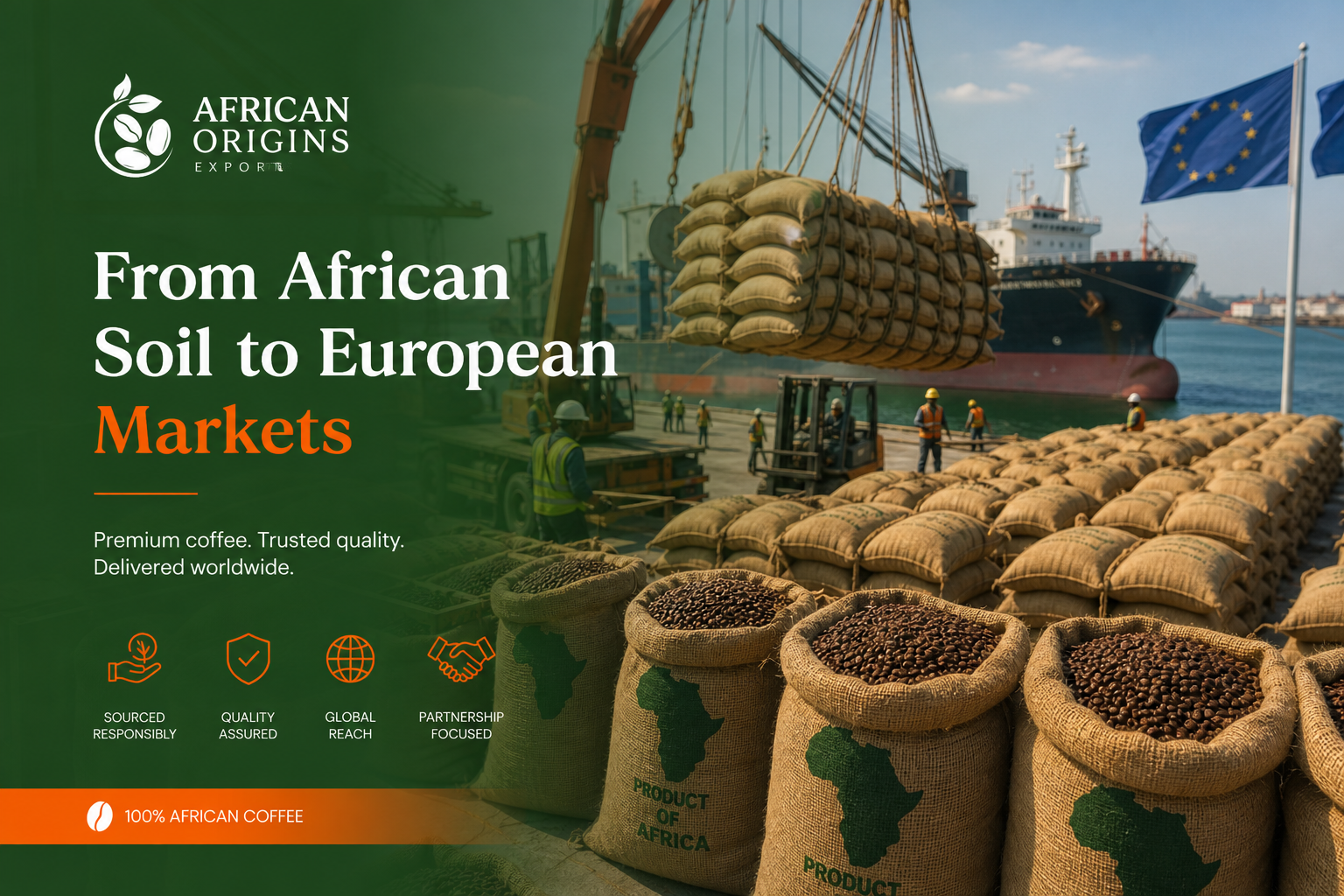
How can African coffee exporters access the EU market in 2026?
African coffee exporters can access the EU market in 2026 by obtaining the right certifications (Organic, Fair Trade, Rainforest Alliance), complying with EUDR deforestation-free requirements (due diligence statement, geolocation data, voluntary grouping for smallholders), targeting the right price segments (€12-18/kg specialty), and using digital B2B platforms like Alibaba or attending trade shows like SIAL Paris and Gulfood to connect with European buyers.
import NewsletterCTA from '@/components/blog/NewsletterCTA';
The €6 Billion Opportunity
European consumers drink 2.6 million metric tonnes of coffee every year. One-third of green coffee entering the EU comes from Africa — Ethiopia, Kenya, Rwanda, Uganda, Tanzania, and Côte d'Ivoire supply high-value Arabica that commands some of the highest prices on the commodity exchanges.
But 2026 is a different market than 2025.
Three structural shifts have redefined coffee export from Africa to Europe:
- EUDR is now operational — the May 2026 simplification package makes compliance achievable but mandatory. Soluble coffee is now in scope. Deadline: December 30, 2026.
- Organic demand grew 12.3% CAGR in 2026 — the third consecutive year outpacing conventional growth. Premium pricing is expanding.
- Direct trade relationships are replacing commodity channels — specialty buyers at €12-18/kg are bypassing the C-price entirely.
This guide covers everything you need to ship African coffee into the EU in 2026: certifications, pricing benchmarks, EUDR compliance walkthrough, buyer access channels, and the financials that work.
Part 1: The African Coffee Landscape in 2026
Ethiopia: The Origin King
Ethiopia exported ~300,000 tonnes of coffee in 2025-2026, generating approximately $1.43 billion. The country remains Africa's largest coffee exporter and the birthplace of Arabica. Key facts for 2026:
| Metric | Value |
|---|---|
| Annual export volume | ~300,000 tonnes |
| Export revenue (2025-26) | ~$1.43 billion |
| Average export price | $3.45/lb ($7.60/kg) |
| EU market share | ~60% of exports |
| Premium vs C-price | +60-80% |
| Certifications dominant | Organic (45%), Fair Trade (22%) |
Ethiopian coffee reaches EU buyers through the Ethiopia Commodity Exchange (ECX) and increasingly through direct specialty channels. The Sidamo, Yirgacheffe, and Guji regions produce the highest-value lots.
Kenya: The Auction Model
Kenya exports ~50,000 tonnes annually, with its Nairobi Coffee Exchange (NCE) auction setting quality benchmarks for East African Arabica. Kenyan AA grade remains one of the world's most sought-after origins.
| Metric | Value |
|---|---|
| Annual export volume | ~50,000 tonnes |
| Average auction price | $4.20-5.80/lb |
| EU market share | ~55% |
| Direct trade penetration | Growing — 30%+ of specialty volume |
| Key certification | Rainforest Alliance (35% of estates) |
Kenya's direct trade model — where European roasters buy directly from cooperatives rather than through the auction — has accelerated. The government's 2026 coffee reform bill aims to increase farmer payout from the current 30% of FOB price to 50% by 2028.
Rwanda: The Premium Play
Rwanda produces ~20,000 tonnes of fully washed Arabica, almost entirely destined for specialty markets. Prices consistently beat regional averages due to the country's quality-first branding and post-genocide cooperative rebuilding.
| Metric | Value |
|---|---|
| Annual export volume | ~20,000 tonnes |
| Average export price | $4.80-6.50/lb |
| EU market share | ~70% (mostly specialty roasters) |
| Organic share | 55%+ |
| Notable | First African country with fully digital traceability |
Rwanda's coffee board (NAEB) has invested heavily in digital traceability — every bag of Rwandan specialty coffee can now be traced to the washing station and cooperative.
Part 2: Certification Requirements for EU Market Access
European buyers — whether large importers, specialty roasters, or supermarket chains — require certifications. Not optional. The table below compares the three most important certifications in 2026:
| Certification | EU Premium/kg | Cost to Obtain | Timeline | Buyer Requirement | Best For |
|---|---|---|---|---|---|
| EU Organic (Reg. 2018/848) | €2.50-4.00/kg | €3,000-8,000 (group cert) | 24-36 months transition | Required by 70%+ specialty roasters | Ethiopia, Rwanda single-origin |
| Fair Trade (FLO) | €1.50-2.50/kg + min $1.80/lb | €2,000-5,000 | 6-12 months | Required by ~40% of EU importers | Cooperative exports, social premium story |
| Rainforest Alliance | €1.00-2.00/kg | €1,500-4,000 | 3-6 months | Required by EU supermarket chains | Kenya estates, large cooperatives |
| 4C (Common Code) | €0.30-0.80/kg | €500-2,000 | 1-3 months | Baseline for commodity traders | Entry-level, high-volume, lower-grade |
| Regenerative Organic (ROC) | €4.00-6.00/kg *emerging | €5,000-12,000 | 36+ months | Growing — Applegate, major roasters adopting | Premium positioning, US/EU dual market |
Key insight: Regenerative Organic Certified (ROC) is the fastest-growing label in 2026. Applegate Farms now sources all beef hotdogs from regenerative farms. FoodNavigator reports major roasters evaluating ROC adoption for 2027. This is the certification to start now for exporters targeting premium EU buyers.
Certification ROI Calculator
A middle-sized Ethiopian cooperative exporting 40 tonnes/year:
| Scenario | Without Certification | With Organic + Fair Trade | Difference |
|---|---|---|---|
| Price/kg (FOB) | €7.60 | €12.00 | +€4.40 |
| Annual revenue | €304,000 | €480,000 | +€176,000 |
| Certification cost (year 1) | €0 | €10,000 | -€10,000 |
| Certification cost (annual) | €0 | €3,000 | -€3,000 |
| Net gain year 1 | €304,000 | €467,000 | +€163,000 |
| Net gain year 3+ | €304,000 | €474,000 | +€170,000/yr |
ROI on certification: 1,630% in year one.
Part 3: EUDR Compliance — What Changes in 2026
The EU Deforestation Regulation (EUDR) is the single most important regulatory change for African coffee exporters. Here's what you need to know as of July 2026:
The Simplification Package (May 2026)
The European Commission published the EUDR simplification package in May 2026, reducing annual compliance costs by an estimated 75%. Key changes:
| Previous Rule | Simplified Rule | Impact on Coffee Exporters |
|---|---|---|
| Per-shipment due diligence statement | Consolidated batch declarations via voluntary grouping | Smallholder cooperatives can file once per batch, not per container |
| Manual risk assessment per country | Certification scheme repositories + country legislation databases | Hours of research per shipment reduced to minutes |
| Individual declarations for micro-exporters | Simplified declaration form via TRACES | Less paperwork for small cooperatives |
| Coffee = green beans only | Soluble coffee now in scope (added May 2026) | Instant coffee exporters also need due diligence |
| Leather, tyres in scope | Leather, retreaded tyres, product samples excluded | No impact on coffee |
EUDR Compliance Checklist for Coffee Exporters
Step 1: Geolocation Data (Due by December 30, 2026)
Every plot of land where coffee is grown must be geolocated. The EU requires:
- Polygon coordinates (or single point for plots <4 hectares)
- Timestamped and verifiable
- For cooperative exports: can be submitted as a consolidated batch under the new voluntary grouping rules
Step 2: Deforestation-Free Declaration
You must confirm no deforestation occurred on the land after December 31, 2020. This means:
- Satellite imagery verification (many cooperatives now use free EU Copernicus data)
- Certification schemes like Rainforest Alliance and Organic already verify this
- For exports from established coffee regions (Ethiopia highlands, Kenya central highlands), risk is low — most coffee is grown under canopy, not on deforested land
Step 3: Due Diligence Statement (DDS)
Filed through the EU TRACES system:
- Simplified form now available for micro/small operators
- Voluntary grouping allows cooperatives to file one DDS for multiple members
- Certification repositories (Rainforest Alliance, Fair Trade, Organic) now serve as pre-verified risk assessments
Step 4: Submit to EU Importer
Your EU buyer/importer must retain the DDS for 5 years. The regulation holds the importer legally responsible — but the data must come from you, the exporter.
What If You Don't Comply?
- After December 30, 2026: Coffee without a valid DDS cannot clear EU customs
- Penalties: Up to 4% of annual turnover in the EU for the importer
- Practical effect: EU buyers will stop sourcing from origins/cooperatives that cannot produce the required documentation
EUDR Timeline
| Date | Milestone |
|---|---|
| December 30, 2026 | Large/medium operators must comply (covers ~95% of EU imports) |
| June 30, 2027 | Micro/small enterprise compliance deadline |
| Now (July 2026) | Start geolocation mapping if you haven't already — 5.5 months to deadline |
Pro tip: The voluntary grouping provision is specifically designed for African smallholder coffee farmers. If you're a cooperative exporting from Ethiopia or Rwanda, you don't need individual geolocation for every 0.5-hectare plot. Your cooperative can consolidate declarations. Start the conversation with your EU buyer — they'll know which certification repositories are accepted.
Part 4: Fair Trade Pricing in 2026
The Price Ladder
Here's how coffee pricing works in the EU market, from commodity to premium single-origin:
| Grade | EU Price/kg (Green, FOB) | Typical Origin | Buyer Type | Volume |
|---|---|---|---|---|
| Commodity (C-price base) | €6.00-9.00 | Uganda, Tanzania, mass Ethiopia | Traders, large roasters | Container loads (20MT+) |
| Certified (Organic/Fair Trade) | €9.00-13.00 | Ethiopia, Kenya (certified cooperatives) | Mid-size specialty roasters | Pallet loads (5-20MT) |
| Specialty Single-Origin | €12.00-18.00 | Ethiopia Yirgacheffe, Kenya AA, Rwanda | Specialty roasters, direct trade | Small batches (1-5MT) |
| Limited Edition / Cup of Excellence | €18.00-35.00 | Winning lots, microlots | High-end specialty, auction winners | Micro-lots (50-500kg) |
The Fair Trade Minimum Price
Fair Trade guarantees these minimums as of 2026:
| Coffee Type | Fair Trade Minimum (FOB) | With Organic Premium |
|---|---|---|
| Arabica (washed) | $1.80/lb | $2.40/lb |
| Arabica (natural) | $1.70/lb | $2.25/lb |
| Robusta | $1.05/lb | $1.45/lb |
| Additional social premium | $0.30/lb | $0.40/lb |
The current C-price for Arabica (July 2026) is approximately $2.15/lb, meaning Fair Trade minimum is below market for standard Arabica. The premium comes from the $0.30/lb social premium (for community projects) and the organic add-on ($0.60/lb).
Real-World Pricing: What African Origins Earn
| Origin | 2025 Avg Price (FOB) | 2026 Est. Price | Premium vs C-price |
|---|---|---|---|
| Ethiopia Yirgacheffe Organic | $4.20/lb | $4.50-5.20/lb | +110-140% |
| Kenya AA Grade | $4.80/lb | $5.00-5.80/lb | +130-170% |
| Rwanda Fully Washed | $5.20/lb | $5.50-6.50/lb | +155-200% |
| Uganda Robusta | $1.40/lb | $1.50-1.80/lb | -30% (below C-price) |
Source: Ethiopia Coffee & Tea Authority, Kenya Coffee Directorate, NAEB Rwanda, ICE C-price July 2026.
Part 5: How to Find EU Buyers
Channel Comparison
| Channel | Cost | Time to First Sale | Buyer Quality | Best For |
|---|---|---|---|---|
| Alibaba.com | $1,500-5,000/yr (Gold Supplier) | 1-3 months | Medium — 40M+ buyers, AI matching | First-time exporters, volume 5-20MT |
| Trade Shows (SIAL, Gulfood) | €3,000-8,000 (stand + travel) | 3-6 months (event cycle) | High — verified buyers attending to source | Established exporters with samples |
| Direct Trade (roaster outreach) | €500-2,000 (samples + shipping) | 1-6 months | Highest — long-term relationships, best prices | Quality-focused, certified, single-origin |
| European Importer Partnerships | €0 (revenue share model) | 2-4 months | Medium-High — traders with established routes | Volume players, less quality differentiation |
| Apollo.io (Buyer Data) | $49-499/mo | 1-2 weeks (outreach) | Medium — requires filtering | Complementing other channels, CRM pipeline |
Where to Meet Buyers in the Next 6 Months
| Event | Dates | Location | Coffee Focus | Buyer Profile |
|---|---|---|---|---|
| SIAL Paris | October 19-23, 2026 | Paris, France | High — dedicated coffee section | EU specialty roasters, distributors |
| Gulfood | January 2027 | Dubai, UAE | Growing — African coffee pavilion | ME buyers, EU traders with ME distribution |
| London Coffee Festival | November 5-8, 2026 | London, UK | High — specialty buyer focus | UK roasters, cafe chains |
| HOST Milan | October 2026 | Milan, Italy | Medium — espresso supply chain | Italian roasters, equipment distributors |
| World of Coffee | June 2027 (next) | Copenhagen, Denmark | Highest — pure coffee | Specialty roasters only |
Buyer Outreach Template
When contacting EU roasters directly, use this template structure:
Subject: [Origin] [Certification] Coffee — [Key Differentiator]

Hi [Name],

We're [Cooperative Name], a [certified] coffee cooperative in [Country].
We produce [volume] tonnes of [grade] [washed/natural] Arabica from
the [Region] region at [altitude] masl.

Key specs available now:
- Cupping score: [85-90+]
- Available: [X] tonnes, [month/year]
- Certifications: [Organic / Fair Trade / RA]
- Price (FOB): $[X]/lb

We can ship sample packs of 5kg within 5 business days.

Are you currently sourcing [Origin] coffee?

Best regards,
[Name]
[WhatsApp number]
Part 6: The Business Case — Sample Financial Model
Here's a realistic financial model for a cooperative exporting 40 tonnes of Ethiopian organic coffee to the EU per year:
| Item | Per Shipment (20MT container) | Annual (2 containers) |
|---|---|---|
| Revenue | ||
| FOB price ($4.80/lb = $10.58/kg) | $211,600 | $423,200 |
| Costs | ||
| Production cost ($2.50/lb) | $110,231 | $220,462 |
| Certification (Organic + FT) | $1,500 | $3,000 |
| Processing (washing, drying, grading) | $15,432 | $30,864 |
| Bagging & export logistics | $4,409 | $8,818 |
| Inland transport to port | $6,614 | $13,228 |
| Export documentation (COO, phytosanitary) | $882 | $1,764 |
| Port handling & freight (Mombasa → Hamburg) | $8,500 | $17,000 |
| Total Costs | $147,568 | $295,136 |
| Margin (cooperative) | $64,032 | $128,064 |
| Margin per kg | $3.20 | $3.20 |
| Payout to farmers (65% of net) | $41,621 | $83,242 |
Key takeaway: Farmers in this model earn $2.08/lb — compared to the commodity C-price of $2.15/lb, they earn roughly the same per pound. BUT the cooperative retains $46,822/year for operations, community investment, and growth. That margin is what transforms subsistence farming into sustainable business.
Part 7: Tools to Run Your Coffee Export Operation
Recommended Software Stack
| Tool | Purpose | Cost | Best For |
|---|---|---|---|
| Pipedrive (Affiliate) | CRM for buyer relationships, deal tracking | $12-50/user/mo | Managing buyer pipeline, follow-up scheduling |
| Wise (Affiliate) | EU cross-border payments, EUR/USD conversion | 0.5-1% FX fee | Receiving EUR payments, avoiding SWIFT fees |
| Notion (Affiliate) | Export dashboard, compliance tracker, SOPs | $10/user/mo | Documentation templates, EUDR compliance records |
| Calendly (Affiliate) | Buyer meeting scheduling across time zones | $8-12/user/mo | Scheduling calls with EU buyers in different TZs |
| Airtable (Affiliate) | Shipment tracking, inventory, pricing database | $20/user/mo | Multi-shipment tracking, price history |
| Alibaba.com (Affiliate) | B2B marketplace, buyer discovery | $1,500-5,000/yr | New buyer acquisition, RFQ responses |
| MRPeasy (Affiliate) | ERP for production, inventory, cost tracking | $30-60/user/mo | Larger cooperatives needing production ERP |
Summary: Your 90-Day Action Plan
Here's what you should do in the next three months to be EU-ready by the December 30, 2026 EUDR deadline:
Week 1-4: Certifications & Documentation
- ✅ Register for Organic or Fair Trade certification (if not already certified)
- ✅ Start geolocation mapping of all coffee plots (EU Copernicus is free)
- ✅ Open a Wise business account for EUR receipts
- ✅ Set up Notion compliance dashboard
Week 5-8: Buyer Development
- ✅ Create Alibaba.com Gold Supplier listing
- ✅ Send sample packs to 10-15 EU specialty roasters
- ✅ Register for SIAL Paris (October) or submit buyer meeting requests via Calendly
- ✅ Download EU importer list from Apollo.io
Week 9-12: Operations & Logistics
- ✅ Lock freight rates for Q4 shipments (book 4-6 weeks ahead)
- ✅ Prepare EUDR due diligence statement (use TRACES simplified form)
- ✅ Set up Pipedrive pipeline with 10+ EU buyer contacts
- ✅ Finalize pricing sheet (FOB + CFR options) with certification premiums
Frequently asked questions
What certifications do I need to export coffee from Africa to the EU in 2026?
What is the EUDR compliance deadline for coffee exporters?
How much can African coffee exporters earn per kg in the EU market?
Is soluble coffee (instant coffee) subject to EUDR?
Quick facts
Published: 7/13/2026
Reading time: 12 min
Pillars: Coffee
Written by

Jean Marc Koffi
Co-authorJournalist & Export SpecialistLondon
Jean Marc Koffi is an MBA-trained trade specialist who connects African exporters to global buyers, with over $20M in contracts facilitated and expertise recognized by major trade organizations. Noted for rapid buyer network building, he is an experienced speaker and certified in trade facilitation, origin rules, and food safety.

Alocha Massamba
Co-authorFounder, Epifresh & FoodExpoConnectLondon
Alocha Massamba is the founder of Epifresh and FoodExpoConnect. He builds the technology, data and partnerships that connect African food producers and exporters to international buyers — with a focus on fresh-produce supply chains, cold-chain logistics, and the buyer-discovery platforms small and mid-size exporters need to compete with global incumbents.
Explore more export intelligence
Certification • Pricing Strategy • Market Access
5 Certifications Worth More Than a Price Cut in 2026
Stop competing on price. Organic, Fair Trade, Rainforest Alliance, B Corp, and SQF certifications can command 20-300% price premiums for African food exporters in 2026. Here is the ROI data for each.
Market Access • Africa Trade • Export Strategy
China Zero-Tariff Policy for African Food Exporters: Coffee Imports Surge 145.7% — How to Enter the World's Largest Market Duty-Free
China's zero-tariff policy covering 53 African countries is already producing dramatic results — coffee imports surged 145.7% in the first five months. How food exporters can access this duty-free window and bypass traditional tariff barriers.
Export Operations • Finance • Middle East Trade
Payment Terms in the Middle East: LC, Cash Against Documents, Open Account (2026 Guide for Food Exporters)
Letters of credit, cash against documents, and open account each carry different risk profiles in Middle Eastern food trade. How to match payment terms to buyer relationships and country risk in Saudi Arabia, UAE, Qatar, and beyond.