
FoodExpoConnect Blog
Food Export Regulations: What You Need to Know (2026)
A practical overview of food export regulations, traceability expectations, and the documents exporters need to ship compliantly into major markets.
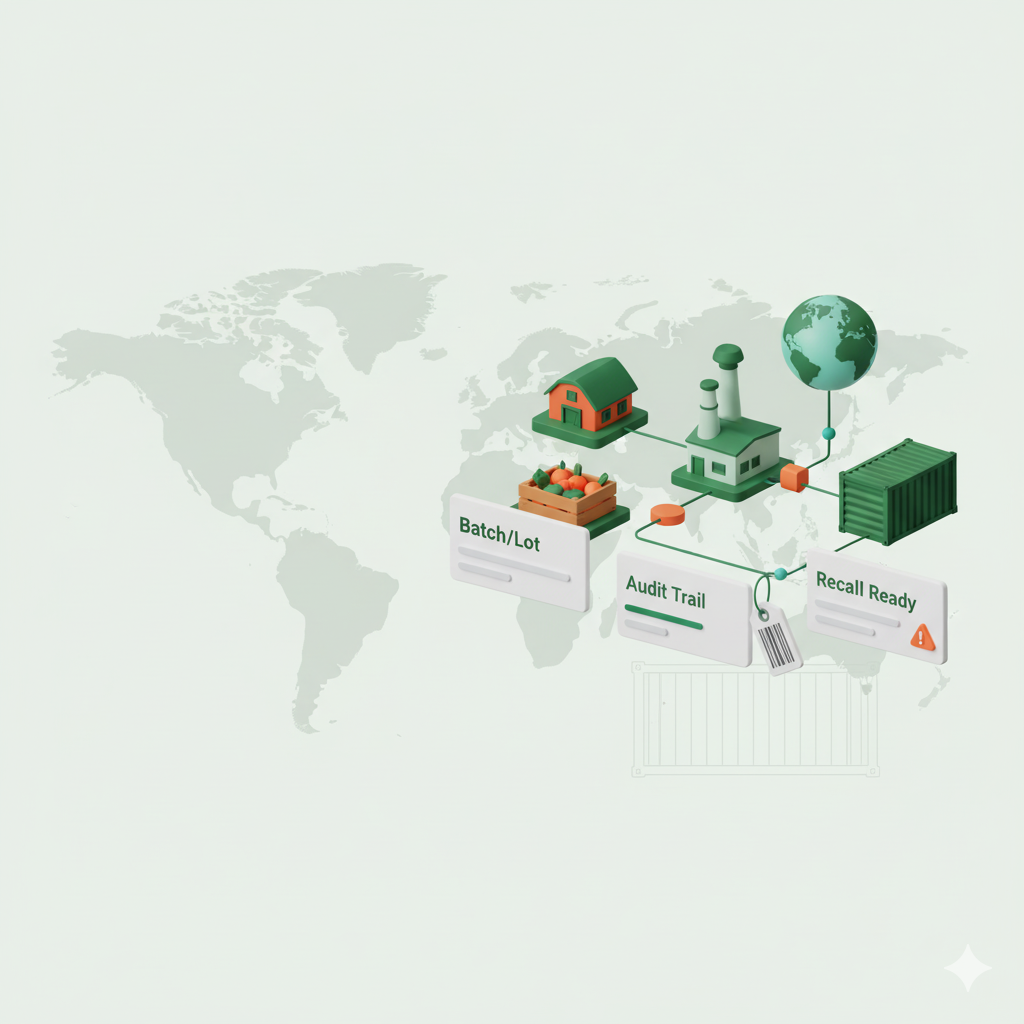
Export Documentation Checklist
Product-specific documentation checklists for sesame, shea, coffee, cocoa, fresh produce, and processed foods
Export regulations can feel overwhelming because they combine:
- destination-market laws and border controls
- buyer and retailer requirements (specs, audits, certifications)
- documentation and labeling rules
This page is a practical starting point to help you understand what's typically required and how to prepare.
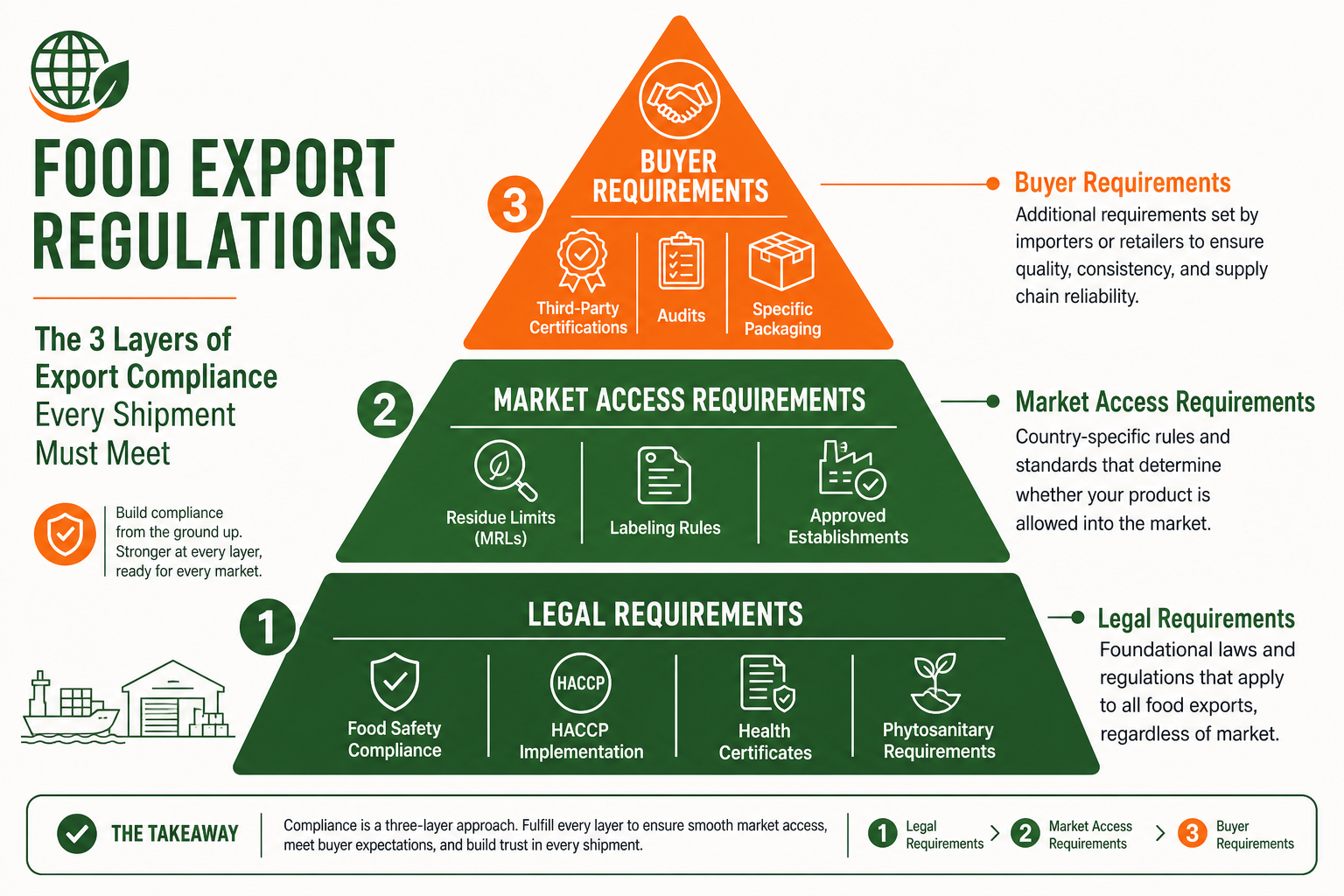
1) The three layers of "export compliance"
A) Legal requirements
These are mandatory rules enforced by authorities. They can include:
- food safety requirements (HACCP-based controls, sanitation, allergen management)
- health certificates / phytosanitary certificates (product-dependent)
- import permits, registrations, or pre-notifications
- traceability and recall readiness
B) Market access requirements
These are conditions to enter a market. Examples include:
- approved establishment lists for certain products
- residue limits or contaminant limits
- packaging/labeling rules (language, net weight, ingredients, allergens)
C) Buyer requirements
These vary by buyer and product category and often include:
- third-party certifications (e.g., GFSI-benchmarked schemes)
- supplier questionnaires, audits, and ongoing evidence
- specific packaging formats, case labeling, pallet configuration
2) Traceability is now a buyer expectation (and often a regulatory one)
Traceability is the foundation for proving compliance and responding quickly to quality incidents.
“Food traceability is the ability to follow the movement of a food product and its ingredients through all steps in the supply chain, both backward and forward.”
Source: FDA — Tracking and Tracing of Food: https://www.fda.gov/food/new-era-smarter-food-safety/tracking-and-tracing-food
“Traceability, or product tracing, is defined by the Codex Alimentarius Commission as “the ability to follow the movement of a food through specified stage(s) of production, processing and distribution”.”
Source: FAO summary of Codex definition: https://www.fao.org/food-safety/food-control-systems/supply-chains-and-consumers/traceability-and-recalls/en/
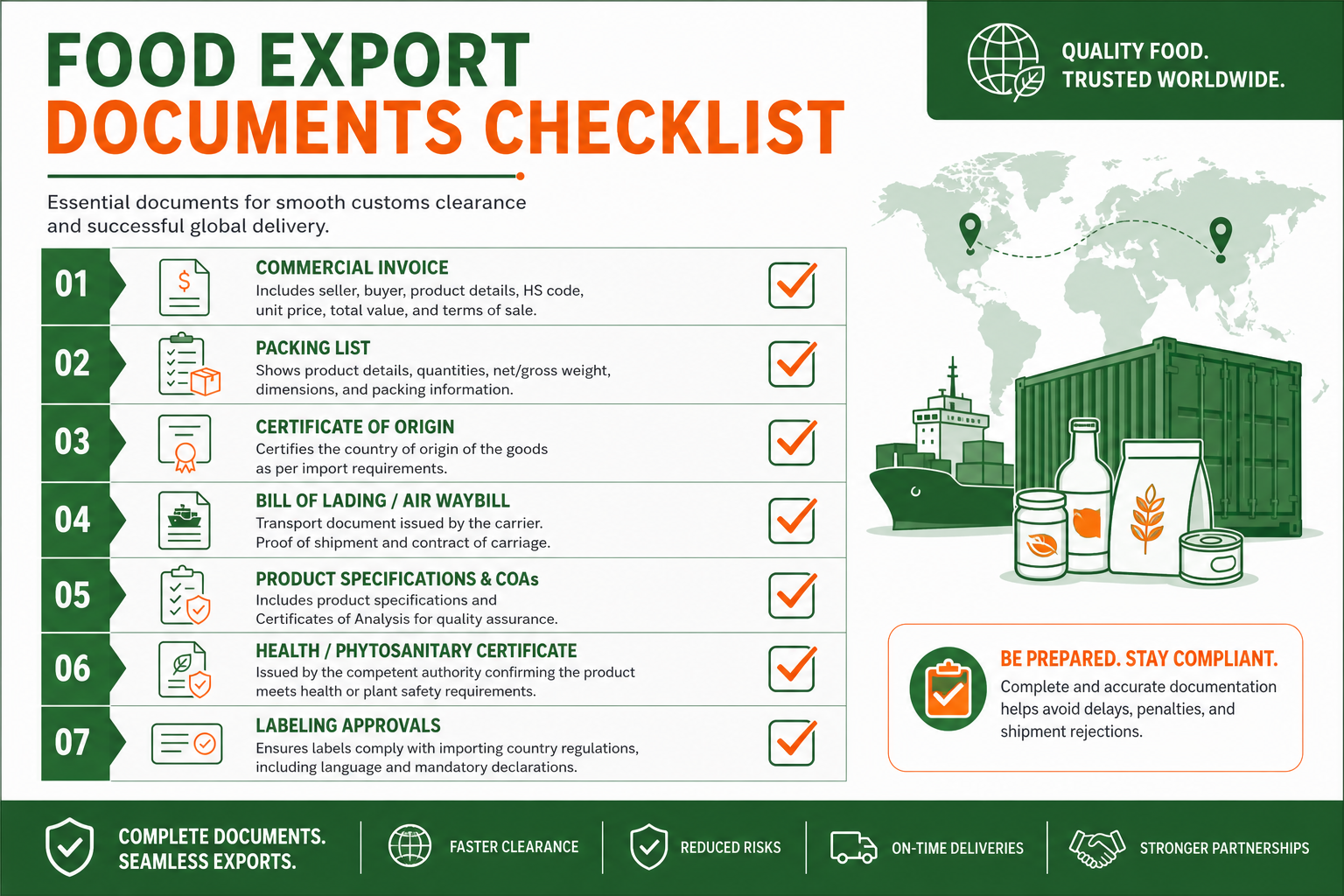
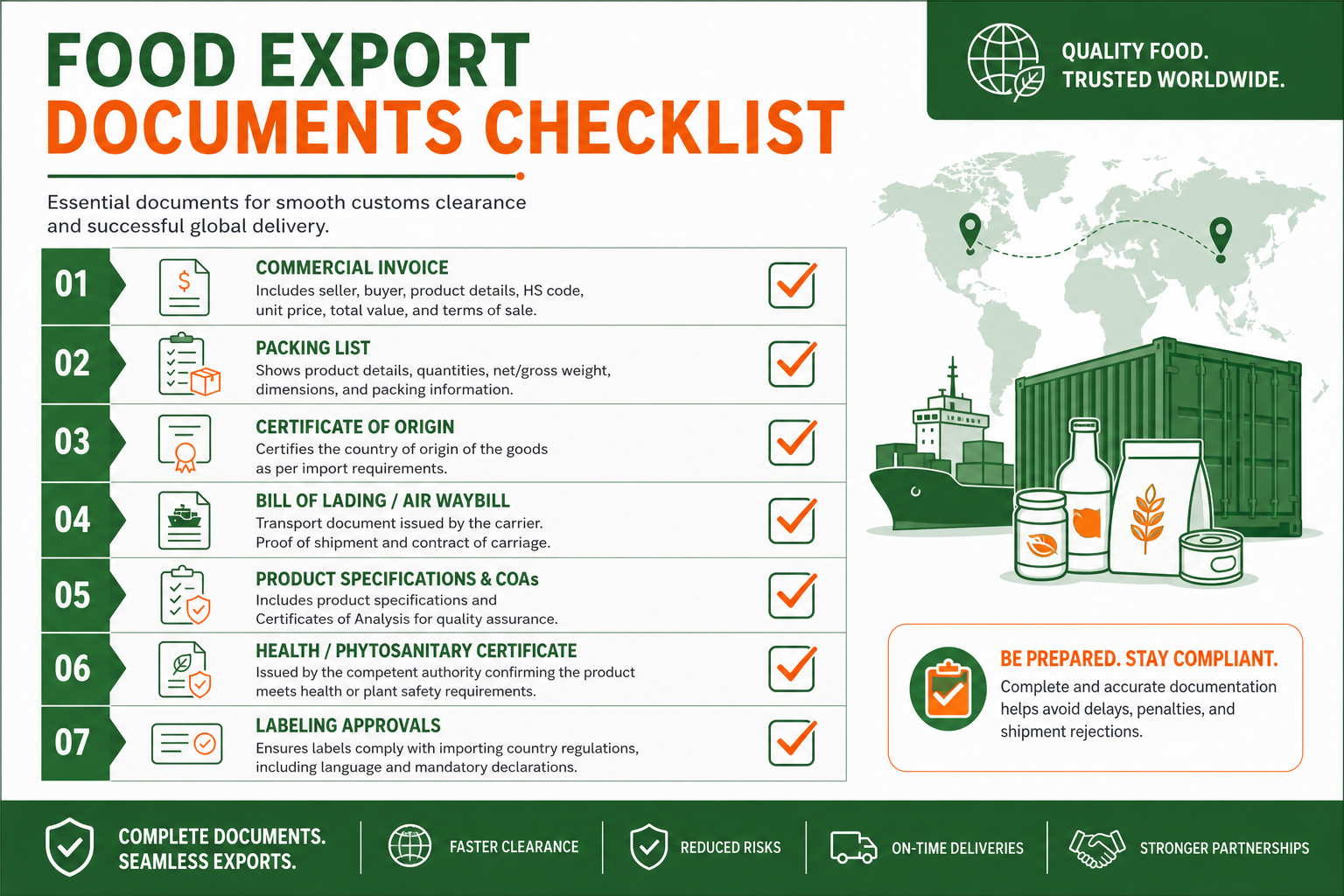
3) The documents exporters usually need (baseline checklist)
Your exact documentation depends on product + destination. A solid baseline includes:
- commercial invoice
- packing list
- certificate of origin (when applicable)
- bill of lading / airway bill
- product specifications and COAs (as required)
- health/phytosanitary certificate (product-dependent)
- labeling/artwork approvals (when required)
4) How to reduce border delays
- verify the HS code and destination import requirements early
- align the label with destination rules (language, allergens, net content)
- keep lot/batch identifiers consistent across:
- production records
- cartons/cases
- shipping documents
- run a “mock recall” so you can prove traceability in hours, not days
Call to action
If you're building your export compliance system, start with our export checklist lead magnet and use it to align your documentation, traceability, and buyer readiness.
You may also find these useful:
✅ Get the Export Documentation Checklist →
Complete documentation checklist for food exports covering: certificates of origin, phytosanitary certificates, health certificates, export licenses, customs declarations, and country-specific requirements for EU, US, China, and Middle East markets.
Free download — no email required.
References
- U.S. FDA — Tracking and Tracing of Food: https://www.fda.gov/food/new-era-smarter-food-safety/tracking-and-tracing-food
- FAO — Traceability & recalls (includes Codex definition): https://www.fao.org/food-safety/food-control-systems/supply-chains-and-consumers/traceability-and-recalls/en/
- European Union — EUR-Lex (EU law): https://eur-lex.europa.eu/
- Codex Alimentarius (FAO/WHO): https://www.fao.org/fao-who-codexalimentarius/
Quick facts
Published: 12/15/2025
Reading time: 7 min
Written by

Jean Marc Koffi
Co-authorJournalist & Export SpecialistLondon
Jean Marc Koffi is an MBA-trained trade specialist who connects African exporters to global buyers, with over $20M in contracts facilitated and expertise recognized by major trade organizations. Noted for rapid buyer network building, he is an experienced speaker and certified in trade facilitation, origin rules, and food safety.

Alocha Massamba
Co-authorFounder, Epifresh & FoodExpoConnectLondon
Alocha Massamba is the founder of Epifresh and FoodExpoConnect. He builds the technology, data and partnerships that connect African food producers and exporters to international buyers — with a focus on fresh-produce supply chains, cold-chain logistics, and the buyer-discovery platforms small and mid-size exporters need to compete with global incumbents.
Explore more export intelligence
Certification • Pricing Strategy • Market Access
5 Certifications Worth More Than a Price Cut in 2026
Stop competing on price. Organic, Fair Trade, Rainforest Alliance, B Corp, and SQF certifications can command 20-300% price premiums for African food exporters in 2026. Here is the ROI data for each.
Coffee Export • Market Access • EU Regulations
Coffee Export 2026: African Origins, Fair Trade Pricing & EU Market Access
Complete guide to coffee export from Ethiopia, Kenya and Rwanda — EUDR compliance, fair trade pricing, certification requirements, and how to access €12-18/kg EU buyer contracts in 2026.
Market Access • Africa Trade • Export Strategy
China Zero-Tariff Policy for African Food Exporters: Coffee Imports Surge 145.7% — How to Enter the World's Largest Market Duty-Free
China's zero-tariff policy covering 53 African countries is already producing dramatic results — coffee imports surged 145.7% in the first five months. How food exporters can access this duty-free window and bypass traditional tariff barriers.