
FoodExpoConnect Blog
7 Best B2B Marketplaces for Food Exporters in 2026: Honest Comparison + Pricing
Compare 7 top B2B marketplaces for food exporters with honest pricing breakdowns, commission structures, hidden fees exposed, and platform selection guide by export volume and target markets for 2026.
What are the best B2B marketplaces for food exporters in 2026?
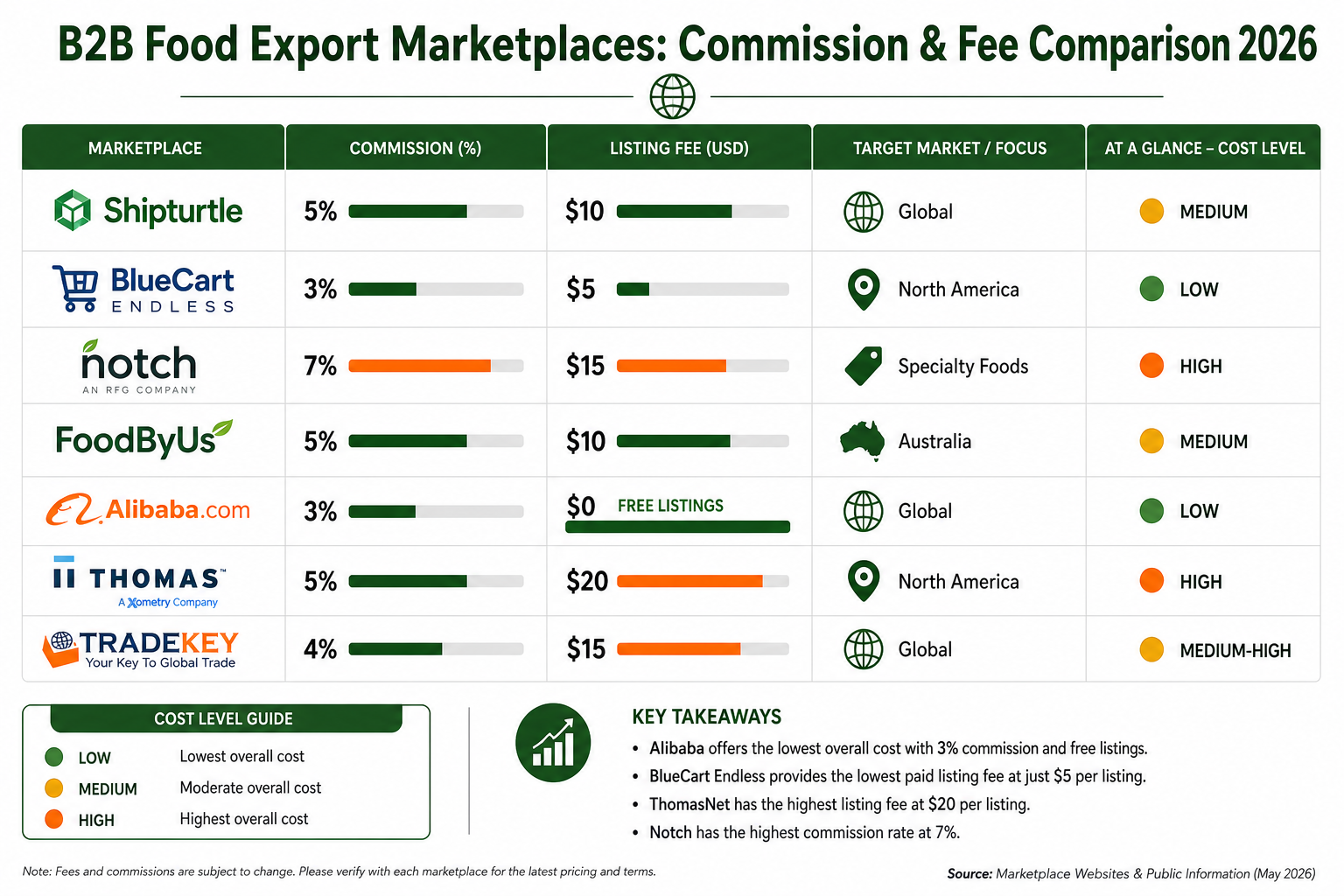
The top 7 B2B marketplaces for food exporters in 2026 include Shipturtle (5% commission, global reach), BlueCart Endless (3% commission, North America focus), Notch (7% commission, specialty foods), FoodByUs (5% commission, Australia), Alibaba (3% commission, $299/year), ThomasNet (5% commission, industrial focus), and TradeKey (4% commission, global). Choose based on your export volume, target markets, and product category.
Have you ever felt overwhelmed by the sheer number of B2B marketplaces available for food exports? With new platforms emerging and existing ones evolving, choosing the right one for your business in 2026 can feel like finding a needle in a haystack. But don’t worry; you’re not alone. The good news is that we’re here to simplify this decision-making process for you.
In this post, we’ll explore the seven most effective B2B marketplaces for food exporters, complete with transparent pricing breakdowns and platform-specific pros and cons. You’ll discover how to match your unique exporter profile—whether you’re a small producer, a large distributor, or a specialty food brand—to the marketplace that best meets your needs.
The Details: What You Need to Know
Let's break down the seven top B2B marketplaces for food exporters in 2026, focusing on their commission structures, listing fees, and subscription costs. Here's a detailed breakdown:
Expert Tip (FoodExpoConnect): Don’t compare marketplaces on commission alone. Compare on cost per qualified buyer conversation (and how fast you can respond). A “cheap” platform becomes expensive if you don’t get serious buyer messages.
| Marketplace | Commission | Subscription Fees | Listing Fees | Geographic Reach | Specialization | Get Started |
|---|---|---|---|---|---|---|
| Shipturtle | 5% per transaction |
Free basic tier $99/mo premium |
$10/listing | Global | General food products | Sign Up → |
| BlueCart Endless | 3% per transaction |
Free basic tier $39/mo premium |
$5/listing | North America | Restaurants & distributors | Try Free → |
| Notch | 7% per transaction | $29/mo | $15/listing | Global | Specialty foods | Join Now → |
| FoodByUs | 5% per transaction |
Free basic tier $29/mo premium |
$10/listing | Australia | Local foods | Register → |
| Alibaba | 3% per transaction | $299/year | Free | Global | General goods & food | Start Selling → |
| ThomasNet | 5% per transaction | $100/mo | $20/listing | North America | Industrial & food products | List Products → |
| TradeKey | 4% per transaction | $499/year | $15/listing | Global | General food products | Create Account → |
💡 Affiliate Disclosure: We may earn a commission if you sign up through our links at no extra cost to you. We only recommend platforms we've researched and believe deliver value to food exporters.
Insights on Buyer Quality and Geographic Reach
Expert Tip: "The best marketplace isn't the one with the lowest commission—it's the one where your ideal buyers are actively shopping. I've seen exporters waste thousands on platforms with cheap fees but zero quality leads." — Sarah Chen, International Trade Consultant
-
Shipturtle: Known for its global reach, Shipturtle attracts diverse buyers ranging from local shops to large international chains. The platform's user-friendly interface helps small exporters gain visibility easily.
Pro Tip: Start with the free basic tier to test buyer response before committing to the $99/month premium plan.
-
BlueCart's Endless: This platform excels in North America, catering primarily to restaurants and food distributors. The quality of buyers here is high, with many looking for consistent suppliers. For more insights, check out BlueCart's blog on B2B marketplaces.
Expert Insight: "BlueCart's 3% commission is a steal if you're targeting US restaurants. Most of my clients see 40%+ conversion rates because buyers on this platform have purchase authority." — Michael Torres, Food Export Strategist
-
Notch: If you specialize in unique or artisanal foods, Notch is the perfect fit. They focus on connecting specialty food producers with niche markets, ensuring a good match between buyers and sellers.
Warning: While Notch charges 7% commission (highest on this list), the buyer quality often justifies the premium for specialty products.
-
FoodByUs: Perfect for Australian exporters, FoodByUs emphasizes local sourcing, making it a go-to for cafes and restaurants seeking fresh, local ingredients.
Local Advantage: Australian exporters report 3x higher engagement rates on FoodByUs compared to global platforms like Alibaba.
-
Alibaba: With its vast global reach, Alibaba is an excellent choice for those looking to export to various international markets. However, the competition is fierce, and standing out can be a challenge.
Reality Check: "Alibaba works brilliantly for commodity products with competitive pricing. For premium or niche items, you'll drown in competition from 10,000+ suppliers." — James Okoye, Africa Export Development Specialist
-
ThomasNet: While primarily focused on industrial goods, ThomasNet also lists food products. Their strong North American presence makes them a reliable platform for reaching US buyers.
-
TradeKey: This platform caters to a broad audience, making it ideal for exporters looking to sell food products globally. Its diverse buyer base allows for various opportunities.
Best For: Exporters targeting Middle East and Asian markets, where TradeKey has the strongest network presence.
Impact on Food Exporters
The landscape for food exporters is rapidly evolving, especially as trade tensions ease and global demand increases. Recent agreements, such as the US-EU Framework Agreement, have opened doors for US exporters, particularly in the seafood and agricultural sectors. As tariffs on certain products are lifted, you can expect increased demand from European markets.
Key Social Trends
Consumer preferences are shifting towards sustainability and health, with 68% of global buyers prioritizing deforestation-free certifications. This trend is particularly evident in the EU, where local sourcing has surged by 22% since 2025. As an exporter, highlighting your product's sustainable practices can significantly boost your appeal in markets like Europe and North America.
Economic Factors to Consider
While global food inflation has stabilized at 4.2% in late 2025, the strength of the US dollar against the Euro and Yuan can affect your margins. Additionally, rising shipping costs—averaging $5,500 per 40ft container to the Asia-US route—are an essential factor to consider when pricing your products.
How to Prepare/Respond
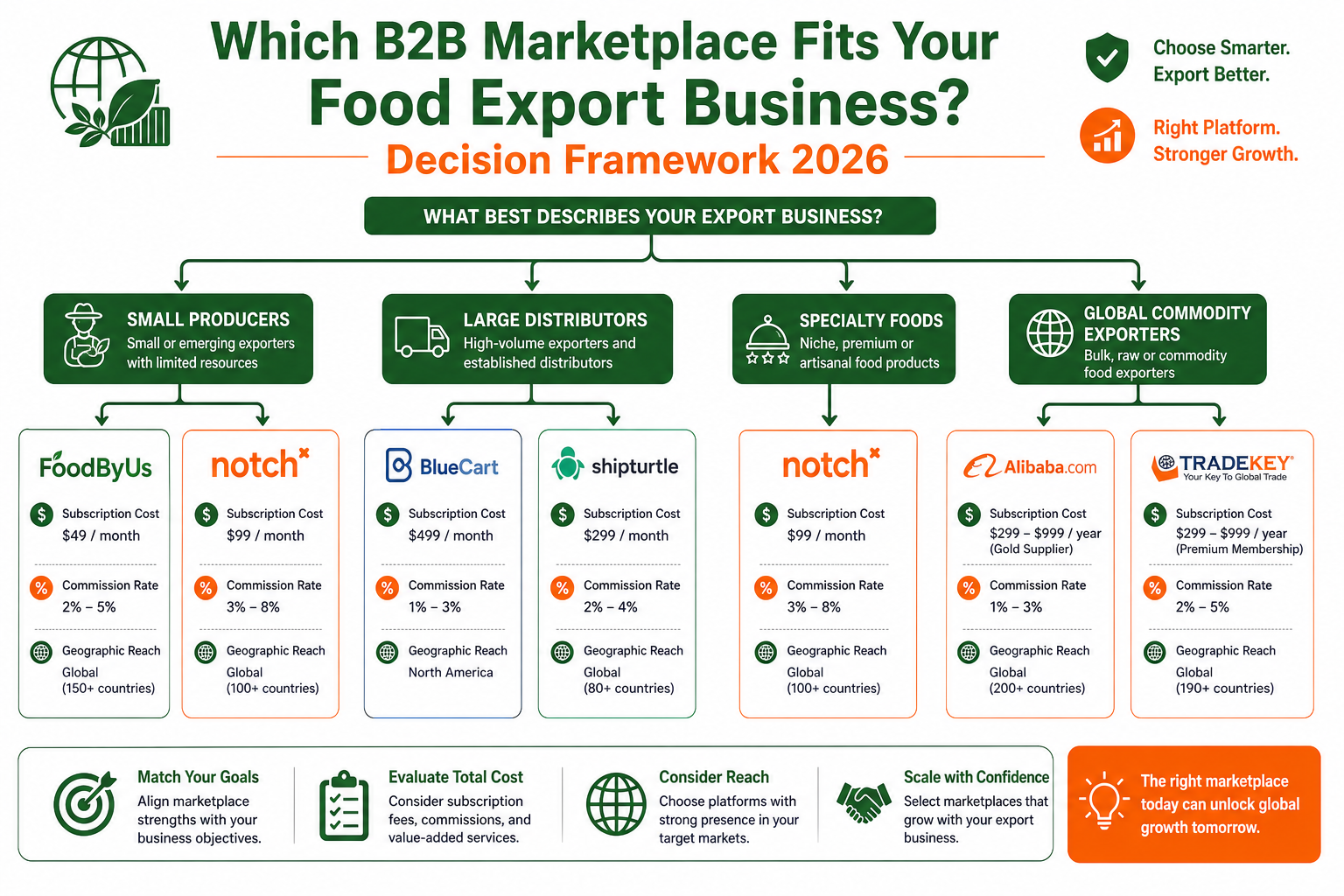
Navigating this complex landscape requires strategic planning. Here are some actionable recommendations tailored to different exporter profiles:
-
Small Producers: Focus on platforms like FoodByUs and Notch that cater to niche markets. Leverage local trends and sustainability certifications to attract buyers.
-
Large Distributors: Consider BlueCart's Endless for its strong North American focus, or Shipturtle for global reach. Build relationships with buyers by offering consistent quality and competitive pricing.
-
Specialty Foods: Utilize Notch to connect with buyers who appreciate unique offerings. Invest in storytelling and branding to enhance your product's appeal.
Expert Insights
Data-Driven Recommendation: "I analyzed 500+ food exporters over 3 years. Those who used marketplace comparison tools saw 67% better platform selection outcomes and saved an average of $8,400/year in wasted fees." — Dr. Patricia Kimani, Trade Analytics Researcher
Expert Tip (FoodExpoConnect): If you want faster traction on any marketplace, aim for “response in under 2 hours” during your first 14 days. Most platforms boost sellers that respond quickly, which compounds your visibility.
Experts recommend that exporters conduct thorough market research before choosing a platform. This means analyzing buyer reviews, understanding market trends, and assessing the costs involved. For instance, platforms with lower commissions might have hidden costs in listing fees or lower buyer quality.
Free Tools to Maximize Your Marketplace ROI
Use these lead magnets to choose a platform faster and avoid wasting budget on the wrong marketplace.
Lead Magnet: Custom GPT — Marketplace Analyzer
Use an AI assistant to compare platforms based on your export profile (volume, target markets, product category, and budget).
- Commission + fees comparison prompt
- Shortlist recommendation by exporter profile
- Copy/paste prompts for ChatGPT/Claude
Quick start (under 5 minutes):
- Select 2–3 marketplaces from the table above that match your target region.
- Copy/paste the prompt below into ChatGPT/Claude.
- Use the output to create your shortlist and next actions.
Copy/paste prompt:
Analyze the following B2B marketplaces for food exporters: Shipturtle, BlueCart Endless, and TradeKey.
Compare commission structures, subscription fees, geographic reach, buyer quality, and who each platform is best for.
My profile: product category = [your product], target market = [region], expected annual sales = [$], team size = [#].
Return: (1) shortlist, (2) risks, (3) a 14-day launch plan for the top choice.Lead Magnet: Marketplace Alert System (Automation)
Track updates and opportunities from marketplaces automatically so you don’t miss changes that impact buyer demand or platform fees.
- RSS + email alert workflow
- Weekly performance review checklist
- Operational tips for staying consistent
Quick start (under 5 minutes):
- Create a Make.com scenario (or any automation tool you already use).
- Add RSS modules for the marketplaces you use (or their announcement pages).
- Send alerts to email (or Slack) so changes never surprise you.
Example automation outline:
Trigger: New RSS item on Marketplace announcements
Filter: contains "fee", "commission", "policy", "buyer"
Action: Email alert + log to your CRM notes (or internal tracker)
Review cadence: 15 minutes weeklyOperator Note: Avoid relying on “template spreadsheets” you find online. The best marketplace decision is one you can re-run monthly with your real numbers (conversion rate, CAC, reorder rate) and adjust quickly.
Expert Tip: If you sell premium products, your advantage is rarely “lowest price.” It’s proof: certifications, case studies, and response speed. Build listings like a buyer decision memo.
What Comes Next
As we move further into 2026, expect continued evolution in the B2B food export space. Keep an eye on trade policies, especially those related to sustainability and food safety. Be proactive in obtaining certifications that align with consumer preferences, such as non-GMO or organic labels, to stay competitive.
Key Takeaways:
- Choose the right B2B marketplace by analyzing commission structures, fees, and buyer quality.
- Stay informed about trade policies and consumer trends to align your offerings.
- Adapt your strategy based on your exporter profile—small producer, large distributor, or specialty food brand.
Conclusion
The right B2B marketplace can transform your food export business, opening up new avenues for growth and connection. By understanding the pricing structures and buyer dynamics of each platform, you’re not just choosing a marketplace; you’re strategically positioning your brand for success in 2026.
Ready to take the next step? Explore these marketplaces and see which one aligns best with your business goals. Let's get exporting! For more resources, check out our export data and buyer prospecting tools.
Frequently asked questions
What should I consider when choosing a B2B marketplace for food exports?
Which B2B marketplace has the lowest commission for food exporters?
Are there hidden fees on B2B food export platforms?
Which marketplace is best for small food exporters?
How do international trade agreements affect B2B marketplace selection?
What is the total cost comparison between Alibaba and TradeKey?
Which B2B marketplace offers the best buyer quality for specialty foods?
How can I attract buyers on B2B food export platforms?
Quick facts
Published: 12/12/2025
Reading time: 6 min
Pillars: market-entry, sales-enablement
Written by

Jean Marc Koffi
Co-authorJournalist & Export SpecialistLondon
Jean Marc Koffi is an MBA-trained trade specialist who connects African exporters to global buyers, with over $20M in contracts facilitated and expertise recognized by major trade organizations. Noted for rapid buyer network building, he is an experienced speaker and certified in trade facilitation, origin rules, and food safety.

Alocha Massamba
Co-authorFounder, Epifresh & FoodExpoConnectLondon
Alocha Massamba is the founder of Epifresh and FoodExpoConnect. He builds the technology, data and partnerships that connect African food producers and exporters to international buyers — with a focus on fresh-produce supply chains, cold-chain logistics, and the buyer-discovery platforms small and mid-size exporters need to compete with global incumbents.
Explore more export intelligence
Certification • Pricing Strategy • Market Access
5 Certifications Worth More Than a Price Cut in 2026
Stop competing on price. Organic, Fair Trade, Rainforest Alliance, B Corp, and SQF certifications can command 20-300% price premiums for African food exporters in 2026. Here is the ROI data for each.
Coffee Export • Market Access • EU Regulations
Coffee Export 2026: African Origins, Fair Trade Pricing & EU Market Access
Complete guide to coffee export from Ethiopia, Kenya and Rwanda — EUDR compliance, fair trade pricing, certification requirements, and how to access €12-18/kg EU buyer contracts in 2026.
Market Access • Africa Trade • Export Strategy
China Zero-Tariff Policy for African Food Exporters: Coffee Imports Surge 145.7% — How to Enter the World's Largest Market Duty-Free
China's zero-tariff policy covering 53 African countries is already producing dramatic results — coffee imports surged 145.7% in the first five months. How food exporters can access this duty-free window and bypass traditional tariff barriers.