
FoodExpoConnect Blog
Best B2B Contact Databases for Food Exporters in 2026: Verified Buyer Lists That Actually Work
Finding verified food buyer contacts is the single biggest bottleneck for small exporters. We compared 8 B2B databases head-to-head on data quality, food industry coverage, and pricing — so you can stop cold emailing dead addresses and start reaching real buyers.
The Hidden Cost of Bad Contact Data
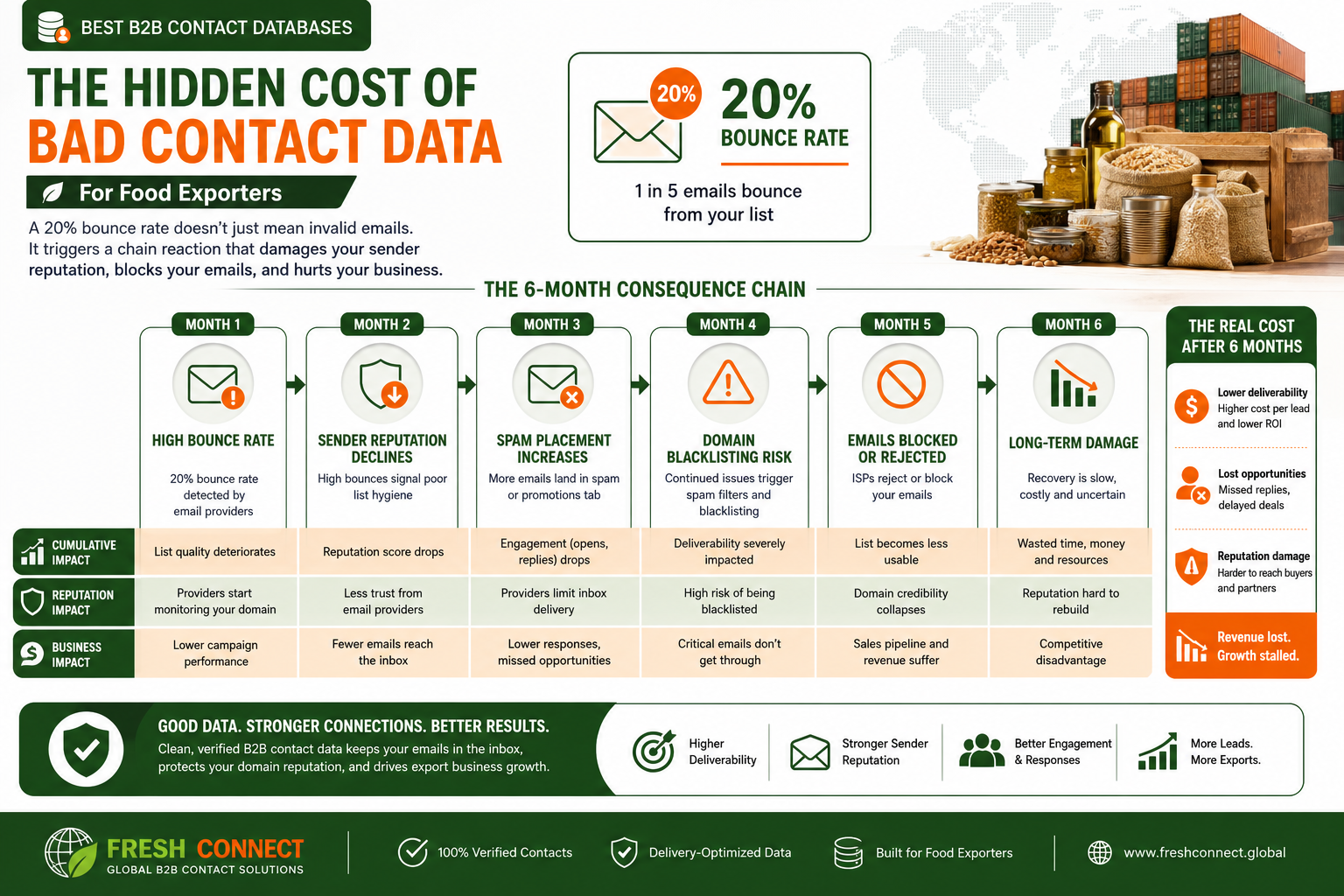
Here is a number most exporters don't calculate: if your email list has a 20% bounce rate, you're not just wasting 20% of your outreach budget. You're actively damaging your sender reputation, which means the remaining 80% of your emails increasingly land in spam folders. Within six months of consistent high-bounce sending, your domain may be blacklisted — making every future email campaign exponentially harder.
Food exporters have a unique challenge. Finding the right buyer isn't just about finding any food company. It's about finding the importer who handles your specific product category, in your target country, with the purchasing authority to make a decision. A generic database of "food companies" is almost useless. You need a database that can answer: "Who are the verified category buyers at European specialty food importers who deal in organic Latin American products?"
We tested eight B2B contact databases specifically for this use case. Here's what we found.
The 8 Databases We Compared
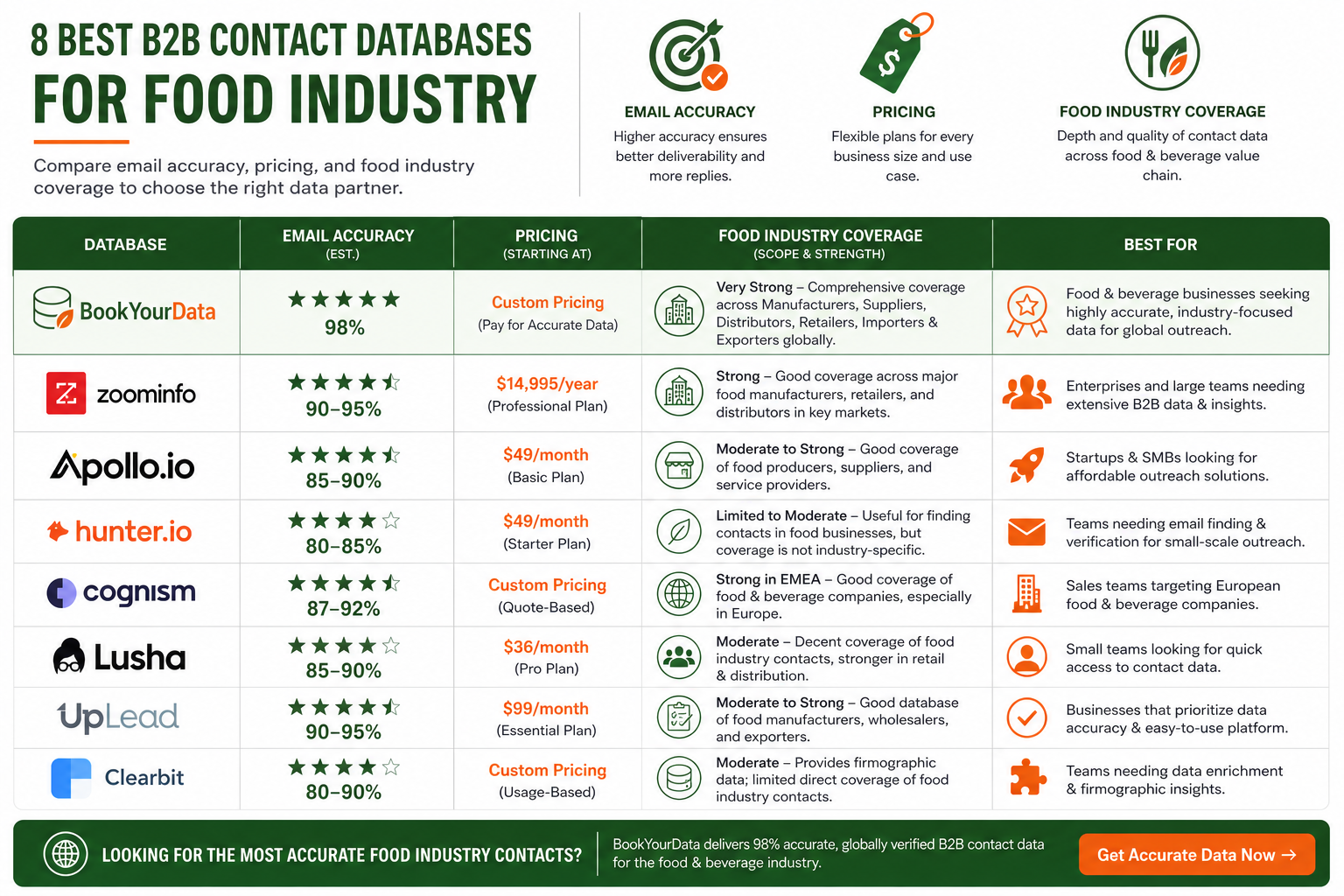
We evaluated each platform on five criteria: email verification accuracy, food industry coverage, country + category filtering, pricing structure, and GDPR compliance for European outreach.
| Database | Email Accuracy | Food Filtering | Pricing | GDPR | Best For |
|---|---|---|---|---|---|
| BookYourData | 95%+ (real-time verified) | ✅ NAICS/SIC codes | Pay-as-you-go from $99 | ✅ DPA available | Small exporters, targeted lists |
| ZoomInfo | 84–92% | ✅ Industry + intent | From $14,000/year | ✅ | Large teams, full-funnel data |
| Apollo.io | 91% | ✅ NAICS codes | Free tier; $49/mo paid | ✅ | Teams wanting CRM integration |
| Hunter.io | ~85% deliverability | ❌ Email only, no filtering | $49/mo for 500 searches | ✅ | Email finding, not list-building |
| Cognism | 98% (phone-verified) | ✅ Industry codes | Custom pricing ~$1,500+/mo | ✅ GDPR-first | EU-focused outreach |
| Lusha | 81% | ✅ Industry filters | $39/mo individual | ✅ | LinkedIn prospecting |
| UpLead | 95% (triple-verified) | ✅ SIC codes | $74/mo for 170 credits | ✅ | SMB prospecting |
| Clearbit | 87% | ❌ General business data | From $20,000/year | ✅ | API enrichment, not direct prospecting |
BookYourData: Why It Tops Our Ranking for Food Exporters
BookYourData was not the most well-known database we tested. But it came out on top for the specific use case of food export prospecting for three reasons.
Real-time verification. Most databases compile contact data and then periodically re-verify it — meaning the email address you download may have been accurate three months ago but has since changed. BookYourData verifies contacts at the point of download. When you export a list, each email is checked against the live mailserver in real time. This is why their bounce guarantee is less than 5% hard bounces — not as a marketing claim, but as a technical reality.
Pay-as-you-go with no expiry. Food exporters often need large lists for a trade show push, then nothing for two months, then another targeted list for a new market. Annual contract databases charge you for the full year regardless. BookYourData lets you buy credits that never expire — you buy what you need, when you need it.
Food-specific filtering. The ability to filter by NAICS code (the US industry classification system) and SIC code (older but still widely used in European databases) means you can pull specifically:
- NAICS 4244xx: Grocery and Related Product Merchant Wholesalers (food distributors)
- NAICS 3119: Other Food Manufacturing
- NAICS 3121: Beverage Manufacturing
- SIC 5140: Groceries and Related Products Wholesale
Combined with country filters, this gets you a list of, say, German wholesale food distributors with verified email addresses in under 15 minutes.
ZoomInfo: The Enterprise Standard (With an Enterprise Price Tag)
ZoomInfo is the database that enterprise sales teams swear by. It has the deepest intent data — tracking when companies are actively researching new suppliers — and the most comprehensive job title filtering. If you need to reach the VP of Procurement at a Fortune 500 food retailer, ZoomInfo is probably your best tool.
The problem for most food exporters is the price. ZoomInfo starts at roughly $14,000 per year for a three-seat minimum. That's a meaningful investment for a business doing $500,000–$2,000,000 in annual export revenue. The ROI calculation works out if you close even one significant account — but the upfront commitment is a barrier.
If you're a mid-size food exporter with a dedicated business development team, ZoomInfo's accuracy and intent data can justify the investment. If you're a small exporter or testing a new market, it's too expensive to start with.
Apollo.io: The Best Free Starting Point
Apollo.io has become the go-to for teams that want CRM integration built into their prospecting tool. It has 275 million contacts, a generous free tier (50 email exports per month), and native integrations with Salesforce, HubSpot, and Pipedrive.
For food exporters already using Pipedrive (our recommended CRM — see our Pipedrive review), Apollo.io connects directly. You can prospect for food importers in Apollo, add them to a sequence, and they automatically sync to your Pipedrive pipeline.
The limitation: Apollo's data skews toward the US and UK tech sectors. Food industry coverage — especially for importers in emerging markets like Southeast Asia, the Middle East, and North Africa — is thinner than BookYourData's more globally balanced database.
Hunter.io: Email Finding, Not List Building
Hunter.io is excellent at one specific task: finding the email format for a company you already know about. If you meet a buyer at Anuga and want to find the email for their procurement director, Hunter.io will likely give you the answer.
What it can't do is generate a list of buyers you don't already know about. It has no industry filtering, no country + category combination search, and no lead generation capabilities. It's a complementary tool to a proper B2B database, not a replacement.
Cognism: The European Compliance Champion
Cognism has built its reputation on GDPR compliance first. They operate a "Diamond Data" verification process that phone-verifies mobile numbers — achieving 98% accuracy on direct dials, which is significantly higher than any other database we tested.
If your primary target market is Europe and you need phone-verified contacts for cold calling alongside email outreach, Cognism is the strongest option. The pricing is custom (expect $1,500–$4,000 per month for a small team), which puts it between Apollo.io and ZoomInfo in cost.
How to Choose: A Framework for Food Exporters
The right database depends on three factors: your target market geography, your outreach volume, and your budget model preference.
If you're testing a new market (under 500 contacts, focused on one or two countries): Start with BookYourData's pay-as-you-go. Download 200–300 verified contacts, run a test campaign, measure response rates before committing to a larger purchase. Total cost: under $200.
If you're building an ongoing outreach engine (1,000+ contacts per quarter, multiple markets): Apollo.io's paid tier ($49–99/user/month) gives you the best balance of volume, CRM integration, and cost. Use BookYourData for markets where Apollo's coverage is thin.
If you need European phone-verified contacts: Cognism. Specifically for enterprise retail buyers in Germany, UK, France, and Benelux where calling is part of the sales process.
If you have an enterprise sales team with budget: ZoomInfo's intent data and depth of coverage justifies the cost at scale.
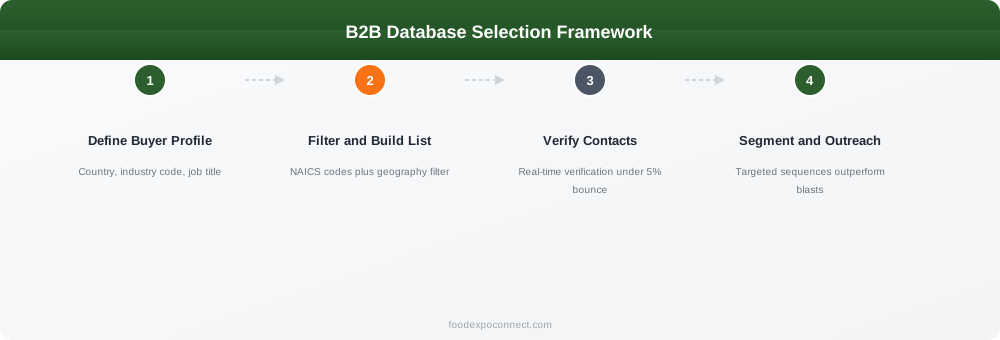
The 4-Step Process for Building a Food Buyer List
Once you've chosen your database, the actual list-building process follows the same pattern regardless of platform.
Step 1: Define your ideal buyer profile. Before touching the database, write down: What country? What company size (by employees or revenue)? What industry sub-category (importer, distributor, retailer)? What job titles (Head of Purchasing, Category Manager, Import Director)? The more specific this is, the higher-quality your list.
Step 2: Build and filter. In BookYourData: select country → select NAICS/SIC code → filter by company size → filter by job title. Expect a raw list of 300–2,000 contacts depending on market size and specificity.
Step 3: Verify and download. BookYourData verifies at download (real-time). Other platforms: run the list through an email verification tool like NeverBounce or ZeroBounce before importing into your CRM or email tool.
Step 4: Segment before outreach. Don't email the entire list with the same message. Segment by country (different regulations, different values propositions), by company size (importer vs. large distributor), and by product category alignment. A 50-contact targeted sequence outperforms a 500-contact blast every time.
The Data Quality Trap: What the Accuracy Numbers Don't Tell You
A database claiming "95% accuracy" can still give you useless data. Here's why: accuracy rates typically measure whether the email address is syntactically valid and the mailserver accepts mail — not whether it reaches the actual decision-maker.
An email address like info@company.com may have 100% deliverability but goes to a generic inbox that nobody monitors. A direct email for marie.dupont@company.com might be 85% likely to work but reaches the actual procurement manager.
When evaluating databases for food export, ask specifically:
- What percentage of contacts have direct email addresses (not generic info@ or contact@)?
- What is the direct dial phone number coverage for decision-makers?
- How often is the database refreshed?
BookYourData's answer to the first question is approximately 60–70% direct emails, which is higher than most competitors. ZoomInfo is similar. Apollo.io depends on the market — stronger for North America, weaker for certain European and Asian markets.
GDPR Compliance for Food Exporters Targeting Europe
If you're targeting buyers in the European Union, GDPR compliance is not optional. The core requirements for using a B2B database for cold email outreach in Europe:
Legitimate interest basis. Under GDPR, sending unsolicited B2B email requires a documented legitimate interest — meaning you have a genuine business reason to contact this specific person and that reason is proportionate to their privacy interests. This is generally defensible for food export outreach (you're contacting a food importer about products they likely source).
Data processing agreement. The database provider must offer a DPA (Data Processing Agreement) documenting how they collected and verified the data. BookYourData, ZoomInfo, Cognism, and Apollo.io all provide DPAs. Keep this on file — it's your evidence that the data was legitimately obtained.
Opt-out mechanism. Every email must include a clear, easy way to unsubscribe. Honor unsubscribes within 10 days. Maintain a suppression list.
Accurate sender identification. Your company name, physical address, and email must be genuine. No deceptive "from" names.
The practical upshot: using BookYourData or another GDPR-compliant database for European food buyer outreach is legal if you follow the above. Where exporters get into trouble is using scraped, unverified, or purchased lists without DPAs — that's where GDPR enforcement has focused.
Earnings Potential: What One Good List Can Do
Let's run a realistic revenue projection. You're a food exporter of premium Colombian cacao. You want to reach specialty chocolate makers and health food importers in Germany and the Netherlands.
Using BookYourData: filter by Country=Germany+Netherlands, NAICS=3119 (Other Food Manufacturing) + 4244 (Wholesale Food), Job Title=Procurement Manager/Import Director/Category Manager. Estimated result: 300–500 verified contacts. Cost: approximately $150–250 to download.
You send a 4-email sequence. Industry benchmarks for cold B2B email in food: 15–25% open rate, 3–6% reply rate. On 400 contacts: 12–24 replies. Of those, 3–6 may progress to samples/quotes. Of those, 1–2 may convert to customers.
If a single customer generates $15,000 in their first year of orders, and you paid $200 for the list, you've achieved a 75x return on your data investment. This is why targeted, verified contact data is the highest-ROI marketing spend for small food exporters — when you use it correctly.
📊 Get the B2B Database Comparison →
Side-by-side comparison of 7 B2B contact databases evaluated for food export prospecting — price per credit, email verification rates, geographic coverage, and food industry filter depth.
Free download — no email required.
Build Your Verified Food Buyer List Today
Start building your verified food buyer list with BookYourData →
Pay-as-you-go pricing from $99 · No annual contract · <5% bounce guarantee · 90-day cookie
FoodExpoConnect earns a commission if you purchase through this link. We only recommend tools we've tested and believe deliver real value for food exporters.
Frequently asked questions
What is the best B2B contact database for finding food buyers?
How accurate are B2B contact databases for food industry contacts?
How much does a food buyer contact list cost?
Is it legal to use B2B contact databases for food export outreach?
Can I find food importers by country using a B2B database?
Quick facts
Published: 6/1/2026
Reading time: 14 min
Pillars: Lead Generation, Sales
Written by

Jean Marc Koffi
Co-authorJournalist & Export SpecialistLondon
Jean Marc Koffi is an MBA-trained trade specialist who connects African exporters to global buyers, with over $20M in contracts facilitated and expertise recognized by major trade organizations. Noted for rapid buyer network building, he is an experienced speaker and certified in trade facilitation, origin rules, and food safety.

Alocha Massamba
Co-authorFounder, Epifresh & FoodExpoConnectLondon
Alocha Massamba is the founder of Epifresh and FoodExpoConnect. He builds the technology, data and partnerships that connect African food producers and exporters to international buyers — with a focus on fresh-produce supply chains, cold-chain logistics, and the buyer-discovery platforms small and mid-size exporters need to compete with global incumbents.
Explore more export intelligence
Certification • Pricing Strategy • Market Access
5 Certifications Worth More Than a Price Cut in 2026
Stop competing on price. Organic, Fair Trade, Rainforest Alliance, B Corp, and SQF certifications can command 20-300% price premiums for African food exporters in 2026. Here is the ROI data for each.
Coffee Export • Market Access • EU Regulations
Coffee Export 2026: African Origins, Fair Trade Pricing & EU Market Access
Complete guide to coffee export from Ethiopia, Kenya and Rwanda — EUDR compliance, fair trade pricing, certification requirements, and how to access €12-18/kg EU buyer contracts in 2026.
Market Access • Africa Trade • Export Strategy
China Zero-Tariff Policy for African Food Exporters: Coffee Imports Surge 145.7% — How to Enter the World's Largest Market Duty-Free
China's zero-tariff policy covering 53 African countries is already producing dramatic results — coffee imports surged 145.7% in the first five months. How food exporters can access this duty-free window and bypass traditional tariff barriers.