
FoodExpoConnect Blog
SeriesQ2 2026 Logistics SeriesHow the Red Sea Crisis Is Reshaping Global Food Export Routes in 2026: What Every Exporter Must Know
The Red Sea shipping crisis is adding $1,500 per container and 14 extra days to food export routes. Here's how smart exporters are adapting their logistics, insurance, and buyer relationships.
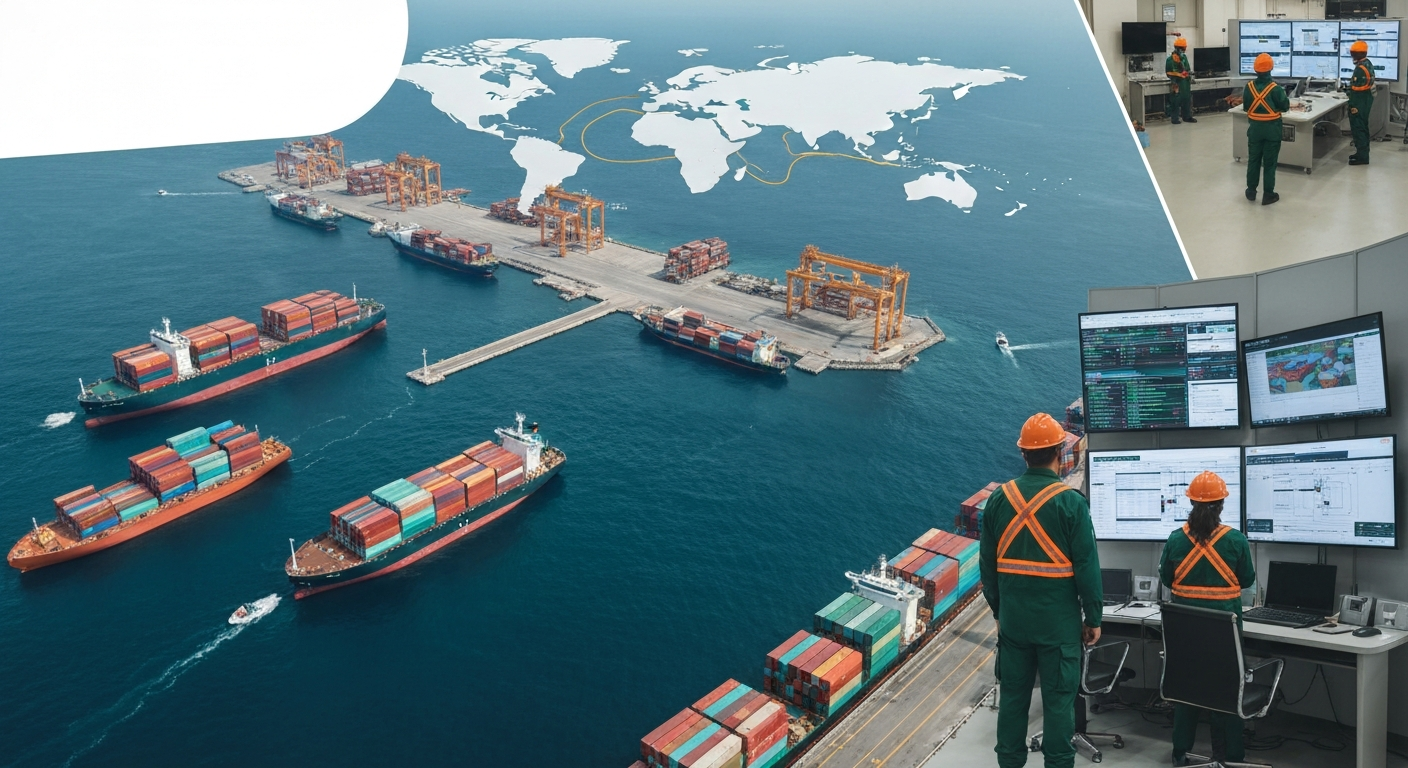
The Red Sea shipping crisis — now entering its third year — has fundamentally altered the economics of global food trade. For food exporters across Africa, Asia, and the Middle East, the question is no longer when shipping will normalise, but how to build a profitable business model around the new reality of Cape routing, elevated insurance premiums, and permanently restructured buyer expectations.
The State of Play: May 2026
As of May 2026, the Bab el-Mandeb Strait — the narrow chokepoint connecting the Red Sea to the Gulf of Aden — remains a no-go zone for most commercial shipping. Despite sporadic announcements of potential returns, major carriers including Maersk, MSC, CMA CGM, and Hapag-Lloyd continue to route the overwhelming majority of their vessels around the Cape of Good Hope.
The numbers tell the story. Nearly 30% of global container trade and a significant share of refrigerated food shipments normally transit the Suez Canal. With Suez traffic down roughly 60-70% from pre-crisis levels, the ripple effects through food supply chains are profound.
The Cost Equation: What Exporters Are Actually Paying
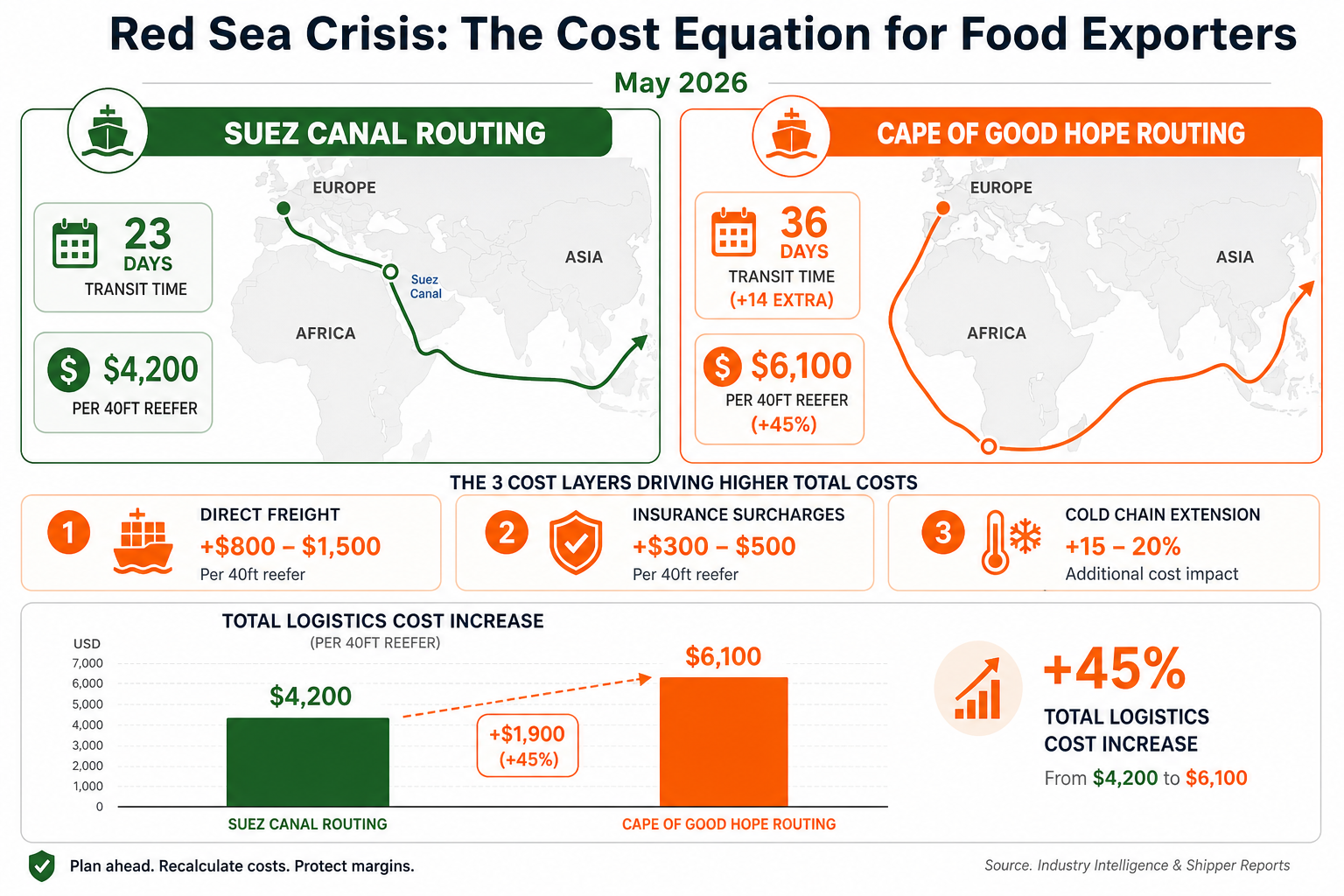
For food exporters, the financial impact breaks down into three distinct layers:
Direct freight costs: The Cape route adds $800-$1,500 per 40ft container in base freight. For a reefer container carrying temperature-sensitive food products, the premium is typically at the upper end of this range.
Insurance and surcharges: War risk premiums add $300-$500 per container for Red Sea-adjacent routes. Even vessels taking the Cape route face elevated hull and cargo insurance costs because the entire ocean freight market has repriced risk.
Cold chain extension: For perishable exports — fresh produce, dairy, frozen goods, chilled meats — the additional 10-14 days of transit time means higher reefer power consumption, more frequent monitoring, and increased spoilage risk. Industry estimates suggest cold chain costs increase 15-20% on Cape-routed shipments.
A small Kenyan avocado exporter shipping to Rotterdam went from $4,200 per reefer container via Suez (23 days) to $6,100 via the Cape (36 days) — a 45% increase in door-to-door logistics cost per shipment.
The Geopolitical Chessboard
The Red Sea crisis is not a single conflict but a convergence of pressures. Houthi forces in Yemen continue to target commercial vessels with drones and anti-ship missiles. Iran's positioning in the Strait of Hormuz adds a parallel layer of risk for Gulf-state food exporters. And the broader Middle East instability that escalated in late 2025 has not de-escalated — it has calcified into a protracted standoff.
The Strait of Hormuz — through which roughly 30% of global oil and a significant volume of Middle Eastern food exports flow — faces its own security premium. For food exporters in the UAE, Saudi Arabia, and Oman, the dual-threat of Hormuz and Bab el-Mandeb disruptions means near-total reliance on alternative routes.
Who Wins and Who Loses
The crisis has created a sharp divergence between exporters positioned near alternative trade corridors and those locked into Red Sea-dependent routes.
Winners
East African exporters with Indian Ocean access: Kenya, Tanzania, and Mozambique have seen increased buyer interest as alternatives to West African origins that required Suez transit. Mombasa and Dar es Salaam ports have reported 12-18% increases in agricultural export volumes since the crisis began.
South African logistics providers: Durban and Cape Town have become critical transshipment hubs. Cold storage facilities in the Western Cape are operating at near-capacity, serving as consolidation points for African food exports heading to Europe and the Americas.
China-Europe Railway Express users: For non-perishable food products (grains, pulses, dried goods, packaged foods), the 18-22 day rail corridor from Chinese production centres to European distribution hubs has become genuinely competitive with ocean freight. Volumes on the route increased 31% in 2025.
Losers
East Mediterranean food exporters: Egyptian, Israeli, and Lebanese food exporters face the highest premiums. Their natural geographic advantage — proximity to European markets — is neutralised when vessels must sail south around Africa to reach customers north of the Suez.
Perishable-only exporters without cold chain investment: Smallholder cooperatives and SME exporters who relied on shorter transit times and minimal cold chain infrastructure are being priced out. A mango exporter who could reach EU markets in 12-14 days via Suez now faces 24-26 days — beyond the shelf life of their product without significant cold chain investment.
Import-dependent East African nations: Somalia, Ethiopia, and Sudan — which rely heavily on imported grains and processed foods — face some of the highest delivered food costs in the world. The Cape route adds $50-80 per tonne for bulk grain shipments to Berbera, Djibouti, and Port Sudan.
Adaptation Strategies That Work
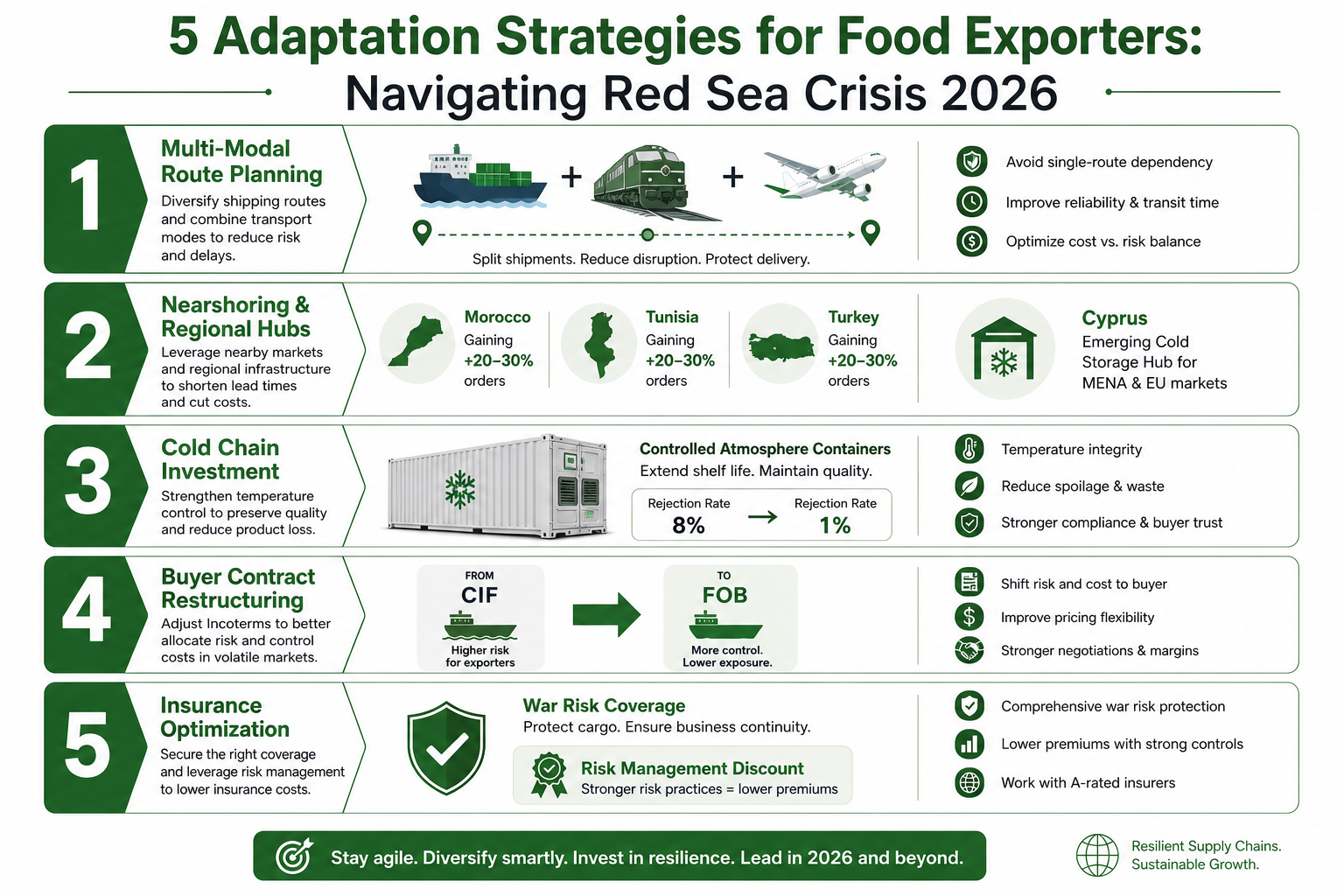 Through conversations with exporters who have successfully navigated the crisis, five patterns emerge:
1. Multi-Modal Route Planning
The most resilient exporters treat ocean freight as one option among several. A cashew exporter in Côte d'Ivoire now splits shipments: bulk containers via the Cape for cost-sensitive European buyers, and air-sea combinations via Dubai for premium Japanese and Korean buyers who demand shorter lead times.
The China-Europe Railway Express has proven especially valuable for packaged and processed food products. Transit times of 18-22 days from Chinese manufacturing hubs to European distribution centres compare favourably to 35-40 days via the Cape, at roughly 40-50% of air freight costs.
2. Nearshoring and Regional Hub Strategy
European food importers are accelerating their shift toward Mediterranean-adjacent sourcing. Moroccan, Tunisian, and Turkish food exporters have seen order volumes increase 20-30% as European buyers reduce exposure to Red Sea-dependent Asian and East African origins.
For exporters in affected regions, the counter-strategy is establishing regional distribution hubs. A Kenyan fresh produce exporter now maintains a small cold storage facility in Cyprus, shipping full containers via the Cape to Cyprus, then breaking bulk for last-mile distribution to European customers — cutting door-to-door lead times by 7 days compared to direct Cape-to-Rotterdam routing.
3. Cold Chain Investment as Competitive Moat
The exporters investing in advanced cold chain technology — controlled atmosphere containers, real-time temperature monitoring, active humidity control — are winning. Not because their product is better, but because their logistics can handle the extra 10-14 days without quality degradation.
A Ghanaian pineapple exporter who invested $180,000 in controlled-atmosphere reefer technology saw their EU rejection rate drop from 8% to under 1% on Cape-routed shipments, while competitors using standard reefers faced 12-15% rejection rates. The investment paid for itself in eight months.
4. Buyer Contract Restructuring
Smart exporters are renegotiating incoterms. Shifting from CIF (Cost, Insurance, Freight — where the exporter bears shipping risk) to FOB (Free On Board — where the buyer takes risk at origin port) transfers the route-risk premium to the buyer and makes the exporter's pricing more predictable.
This requires honest conversations with buyers about the cost structure. Most professional buyers understand the situation — they're seeing the same freight quotes. The exporters who succeed are those who present FOB pricing alongside transparent cost breakdowns rather than absorbing unpredictable route premiums into their margins.
5. Insurance Optimisation
Standard marine cargo insurance does not automatically cover war risk in designated conflict zones. Exporters shipping through or near the Red Sea need explicit war risk coverage, which adds 0.05-0.15% of cargo value to premiums.
However, exporters who have built consistent shipping histories with their insurers and who can demonstrate robust risk management (vessel selection criteria, route diversification, real-time tracking) are seeing more favourable terms. The insurance market is differentiating between exporters who have a risk management strategy and those who don't.
What the Research Shows
A March 2026 study published in the Journal of Shipping and Trade compared the economics of Suez vs. Cape routing for containerised trade. The key finding for food exporters: the Cape route increases total logistics costs by 18-25% for Asia-Europe routes, with perishable cargo at the upper end of the range due to cold chain extension.
The study also found that the carbon footprint of Cape routing is 35-45% higher than Suez routing — a factor that matters increasingly as EU importers face Scope 3 emissions reporting requirements under the Corporate Sustainability Reporting Directive (CSRD). For organic and sustainability-certified food exporters, the carbon premium of Cape routing is becoming a competitive disadvantage in the European market.
Looking Ahead: Scenarios for H2 2026
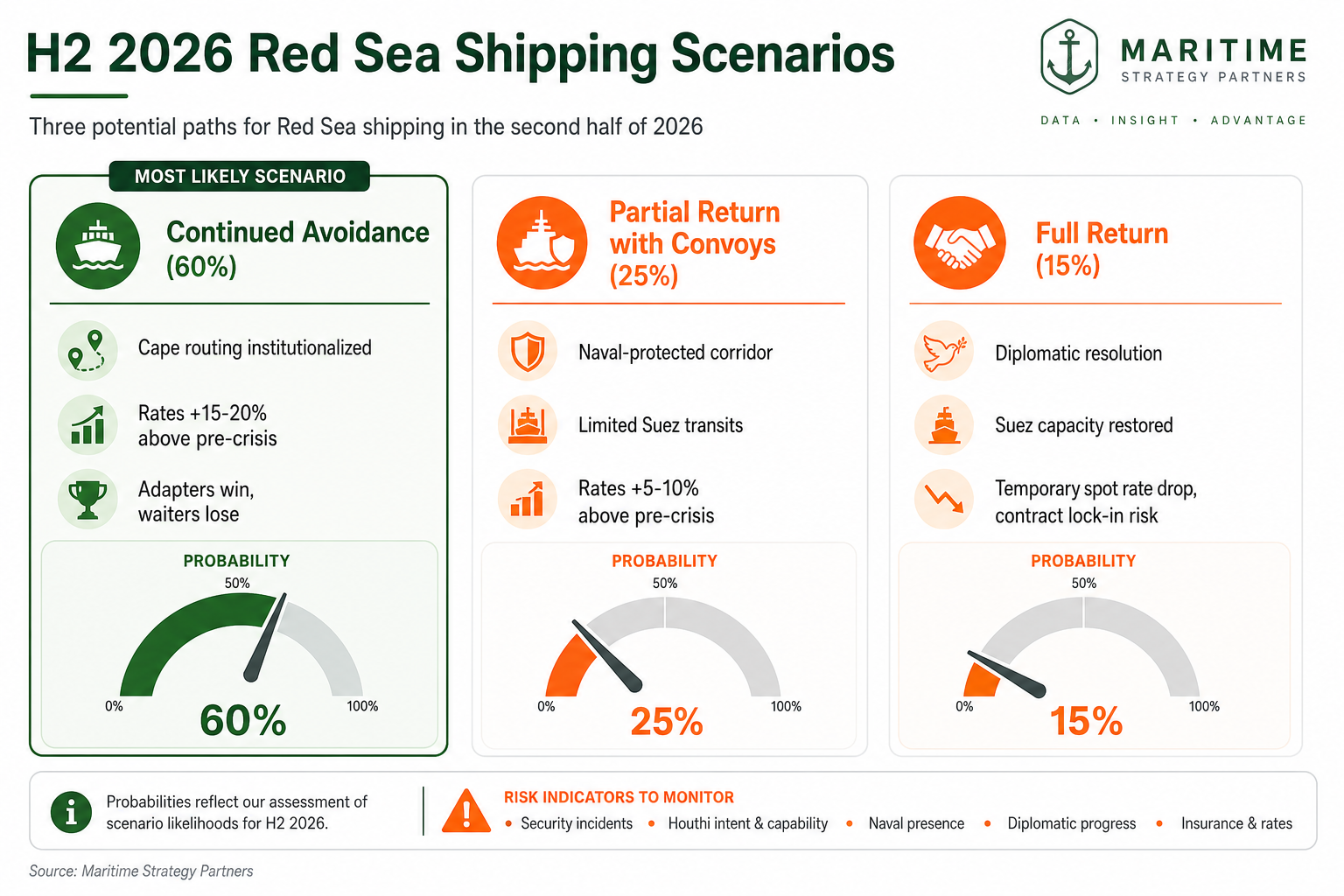 Three scenarios are plausible for the remainder of 2026:
Continued avoidance (60% probability): The Red Sea remains effectively closed to most commercial shipping through Q4 2026. Carriers institutionalise Cape routing, and the "new normal" rate structure stabilises at 15-20% above pre-crisis levels. Exporters who have adapted win; those waiting for a return to normal lose market share.
Partial return with convoy systems (25% probability): A multinational naval coalition establishes a protected corridor, enabling limited Suez transits under military escort. Rates partially normalise but remain 5-10% above pre-crisis levels due to war risk premiums and convoy scheduling constraints.
Full return (15% probability): A diplomatic resolution to the Yemen conflict enables unrestricted commercial transit. The sudden restoration of Suez capacity causes a sharp (but temporary) drop in spot rates as capacity floods back into the market. Exporters locked into high-rate Cape contracts face a disadvantage versus those who can quickly pivot back to Suez routing.
Most logistics analysts and shipping economists I've spoken with consider the 60% scenario most likely. The strategic implication for food exporters: build your 2026-2027 business plan around Cape routing as the baseline, not the exception.
✅ Get the Red Sea Action Checklist →
Five-step action plan for food exporters affected by Red Sea rerouting. Includes cost impact calculator, alternative route options, and carrier contact protocol.
Free download — no email required.
Practical Next Steps for Food Exporters
-
Audit your current shipping contracts. Are you paying Red Sea war risk premiums on Cape-routed cargo? Some forwarders are charging these premiums on all shipments regardless of route — push back.
-
Evaluate multi-modal options. Get quotes for China-Europe Railway, sea-air combinations, and transshipment via Dubai or Salalah. Even if you don't use them, knowing the price points strengthens your negotiation position with ocean carriers.
-
Invest in cold chain monitoring. If your product is temperature-sensitive, real-time monitoring is no longer optional. Buyers are demanding proof of cold chain integrity on the longer Cape transit.
-
Diversify buyer geography. If 80% of your exports go to Europe via Suez-adjacent routes, the crisis is an existential threat. If you also sell to Middle Eastern, Asian, and African buyers, you have options. Diversification isn't just a growth strategy — it's risk management.
-
Build the Cape premium into your pricing. Absorbing route premiums into your margin is a path to bankruptcy. Calculate the real cost difference per container, present it transparently to buyers, and negotiate incoterms that distribute the risk fairly.
Jean-Marc du Plessis is a food export strategist and MBA graduate of INSEAD with 14+ years of experience in African agricultural exports. He has facilitated over $9.5M in food export transactions across 18 countries and holds certifications in ECOWAS trade compliance, AfCFTA rules of origin, and HACCP food safety management.
Frequently asked questions
How much extra does the Red Sea crisis add to food shipping costs?
How much longer do food shipments take when rerouting around the Cape of Good Hope?
Are shipping companies returning to the Red Sea in 2026?
What alternatives do food exporters have to the Suez Canal?
How does the Red Sea crisis affect food commodity prices?
Quick facts
Published: 5/8/2026
Reading time: 12 min
Pillars: Trade Routes, Shipping
Written by

Jean Marc Koffi
Co-authorJournalist & Export SpecialistLondon
Jean Marc Koffi is an MBA-trained trade specialist who connects African exporters to global buyers, with over $20M in contracts facilitated and expertise recognized by major trade organizations. Noted for rapid buyer network building, he is an experienced speaker and certified in trade facilitation, origin rules, and food safety.

Alocha Massamba
Co-authorFounder, Epifresh & FoodExpoConnectLondon
Alocha Massamba is the founder of Epifresh and FoodExpoConnect. He builds the technology, data and partnerships that connect African food producers and exporters to international buyers — with a focus on fresh-produce supply chains, cold-chain logistics, and the buyer-discovery platforms small and mid-size exporters need to compete with global incumbents.
Series
More in Q2 2026 Logistics Series
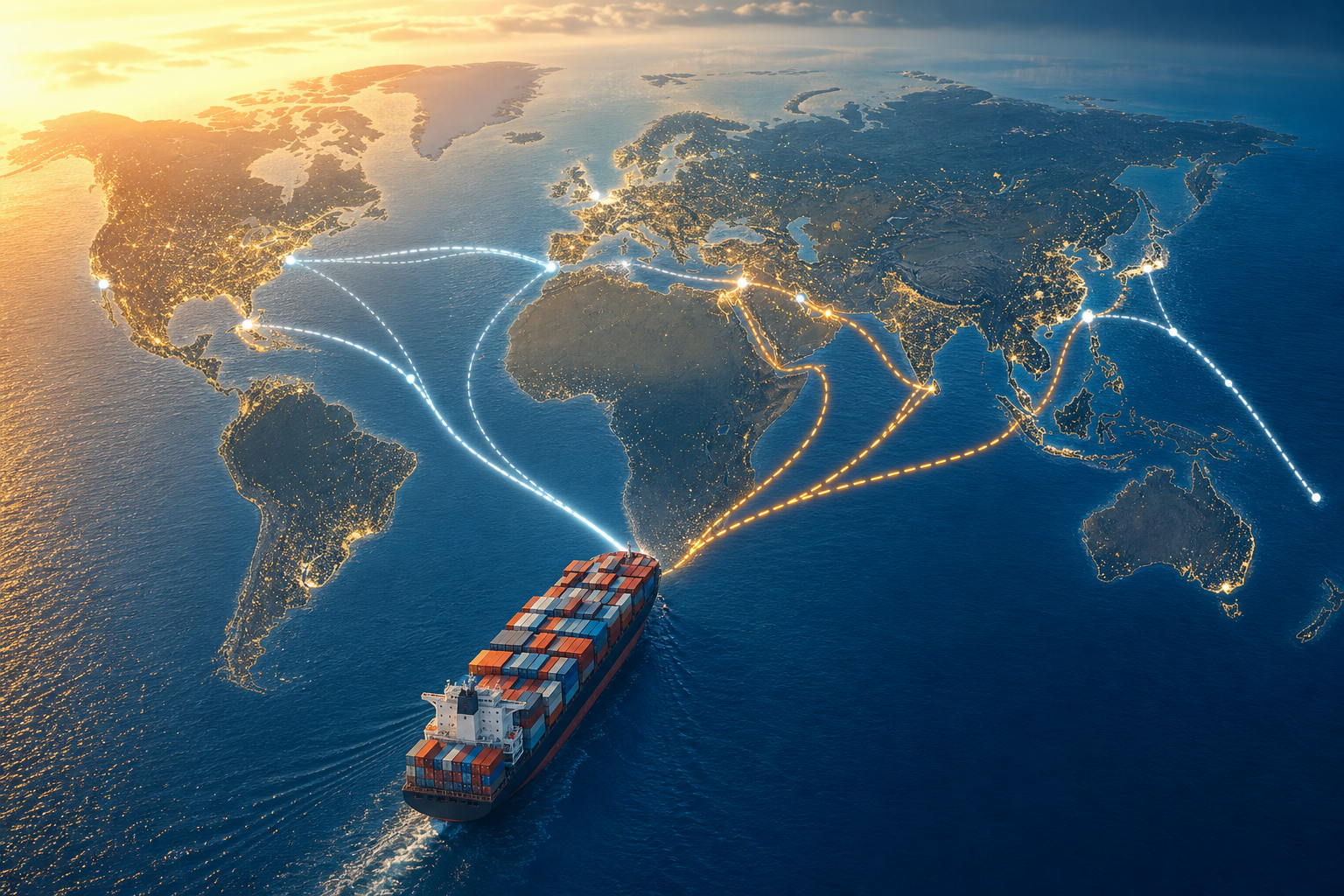
Ocean Freight Q2 2026: Why Container Rates Are Dropping on Some Routes and Surging on Others
A tale of two shipping markets: transpacific rates have collapsed 70% from their 2022 peak while Asia-Europe spot rates surge 40% on Iran disruption. Here's what it means for food exporters and how to route around the volatility.
Container Shipping Rates Q2 2026: What Food Exporters Need to Know About Falling Freight Costs, Blank Sailings, and the Suez Return
Container rates have dropped 70% from pandemic peaks, Suez transits are resuming, and fleet overcapacity is 3-5%. But the rate bottom may be short-lived. Here's how food exporters should position their logistics strategy for Q2-Q3 2026.
How the Middle East Conflict Is Disrupting Global Food Trade: What Every Exporter Must Know in 2026
The 2026 Iran war and Strait of Hormuz closure have shattered global shipping routes, spiked freight costs by 300%, and triggered a fertiliser crisis. Here is what food exporters need to do right now.
Explore more export intelligence
Certification • Pricing Strategy • Market Access
5 Certifications Worth More Than a Price Cut in 2026
Stop competing on price. Organic, Fair Trade, Rainforest Alliance, B Corp, and SQF certifications can command 20-300% price premiums for African food exporters in 2026. Here is the ROI data for each.
Coffee Export • Market Access • EU Regulations
Coffee Export 2026: African Origins, Fair Trade Pricing & EU Market Access
Complete guide to coffee export from Ethiopia, Kenya and Rwanda — EUDR compliance, fair trade pricing, certification requirements, and how to access €12-18/kg EU buyer contracts in 2026.
Market Access • Africa Trade • Export Strategy
China Zero-Tariff Policy for African Food Exporters: Coffee Imports Surge 145.7% — How to Enter the World's Largest Market Duty-Free
China's zero-tariff policy covering 53 African countries is already producing dramatic results — coffee imports surged 145.7% in the first five months. How food exporters can access this duty-free window and bypass traditional tariff barriers.