
FoodExpoConnect Blog
SeriesUS–China Trade Reset 2026US-China Trade Deal May 2026: What the Trump-Xi Summit Means for African and Latin American Food Exporters
The Trump-Xi Beijing summit produced a commitment for China to buy 25 million metric tons of US soybeans annually through 2028 — and 'double-digit billions' in broader agricultural purchases. Here's what the reconfigured US-China food corridor means for exporters in Africa and Latin America.
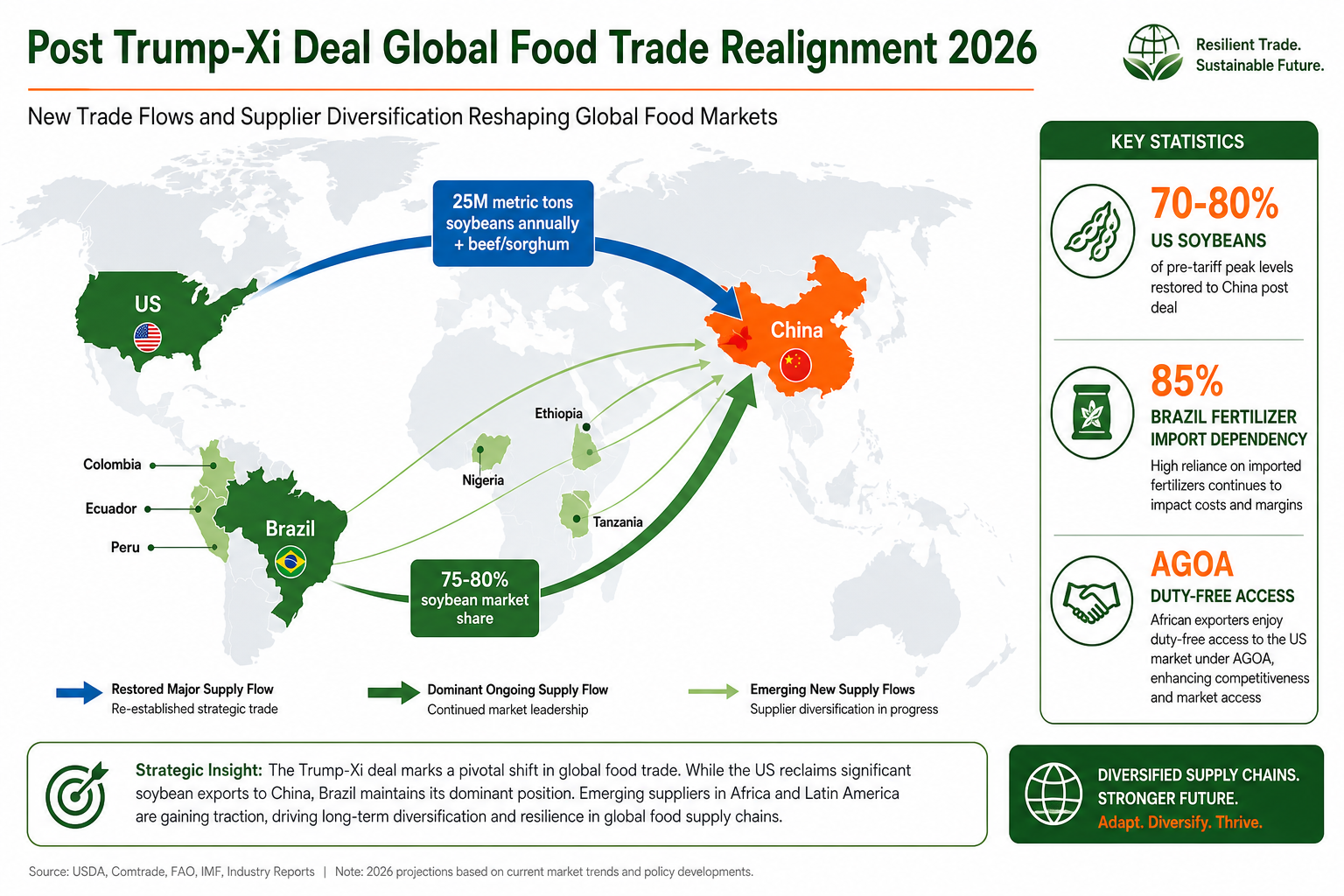
The May 2026 Trump-Xi summit in Beijing has produced the most significant reset in US-China agricultural trade relations since the tariff war began. The headline commitment — China purchasing "double-digit billions" of US agricultural products annually, including 25 million metric tons of soybeans per year through 2028 — represents a partial thaw in a trade relationship that had frozen solid through 2025.
For food exporters in Africa and Latin America, the question is not whether this deal matters — it matters enormously. The question is whether it represents a threat (your competitors regaining access to the world's largest agricultural import market) or an opportunity (a rising tide of Chinese food import demand that lifts all suppliers who are ready).
The answer, as with most things in global food trade, is: both. And the exporters who understand which side of the equation they're on will be the ones who thrive.
What you'll learn:
- The specific terms of the May 2026 Trump-Xi agricultural agreement and what's actually enforceable
- How the China-Brazil soybean corridor is evolving — and where the gaps are opening
- Which African and Latin American food categories have the greatest near-term opportunity in China
- The US market access opportunity for non-tariffed exporters as the North American food trade restructures
- A practical four-step strategy for positioning your food export business for the reconfigured trade landscape
The Trump-Xi Deal: What's Actually in It
On 15 May 2026, US Trade Representative Jamieson Greer confirmed that China is expected to commit to "double-digit billions" of US agricultural purchases annually following the Trump-Xi summit. The specific commitments, as reported by University of Illinois Farm Policy News and corroborated by multiple trade sources, include:
- Soybeans: At least 25 million metric tons of US soybeans annually from 2026 through 2028
- Sorghum and coarse grains: Additional purchase commitments beyond soybeans
- Beef and pork: Expanded access for US protein exports
- Broader farm products: A catch-all category that could include corn, wheat, dairy, and processed foods
The numbers are significant. US soybean exports to China peaked at roughly $14 billion in 2020 before declining by an estimated 40-50% during the tariff escalation. Restoring 25 million metric tons annually would bring US-China soybean trade back to roughly 70-80% of pre-tariff peak levels — a substantial recovery, but not a full restoration.
The agreement also signals something more important than the specific tonnage: a Chinese willingness to engage with global agricultural suppliers after a period in which Beijing appeared content to concentrate its sourcing in Brazil and, to a lesser extent, Argentina and Ukraine.
What's Not in the Deal
The agreement is a political commitment, not a legally binding purchase contract. China's track record on agricultural purchase commitments is mixed — the Phase One deal of 2020 saw China purchase only 58% of the two-year commitment, and none of the additional $200 billion in US exports that had been promised.
For food exporters watching from Africa and Latin America, this is the key variable: if China fully executes the soybean commitment, US soybeans re-enter the Chinese market at scale and competition intensifies. If China under-executes — as it has done before — the status quo of Brazil-dominated Chinese soy sourcing continues, and the opportunity for alternative suppliers remains.
The China-Brazil Soybean Corridor: Cracks in the Foundation
Brazil has been the single biggest beneficiary of US-China agricultural trade disruption. Brazil's share of Chinese soybean imports rose from roughly 60% pre-tariff to an estimated 75-80% by early 2026. Brazilian soybean farmers expanded planted area by 8-12% in the Cerrado region, and Brazilian agricultural exports reached record levels in 2025.
But the Brazil-China soybean corridor is not without vulnerabilities — and those vulnerabilities create openings for other suppliers.
Concentration Risk
Chinese food importers, burned by their over-reliance on US supply in the first phase of the trade war and now increasingly uncomfortable with their near-total dependence on Brazilian supply, are actively seeking diversification. The Trump-Xi soybean commitment is one piece of that diversification strategy. But so is China's growing interest in African and Southeast Asian agricultural supply.
Chinese state-owned food companies — COFCO, Beidahuang Group, and others — have opened procurement offices in Ethiopia, Tanzania, and Mozambique. These offices are primarily focused on soybeans, sesame, and cashews, but their presence signals a long-term strategic interest that goes beyond any single commodity or trade deal.
Logistical Bottlenecks
Brazil's agricultural export infrastructure is operating near capacity. The port of Santos — through which roughly 30% of Brazilian agricultural exports flow — faces chronic congestion during the harvest season. The Northern Arc ports (Barcarena, Itaqui, Santarém) have expanded capacity but cannot fully absorb peak-season volumes.
For Chinese importers, the reliability of supply matters as much as price. A supplier who can deliver 25 million metric tons on schedule at a competitive price is ideal. A supplier who can deliver 25 million metric tons but faces periodic logistical disruptions creates an incentive to maintain alternative sourcing relationships.
The Fertiliser Factor
Brazil imports approximately 85% of its fertiliser needs — primarily from Russia, China, and the Middle East. Every one of those supply routes faces disruption: China's May 2026 sulfuric acid export restrictions, the Hormuz Strait disruption affecting Middle Eastern fertiliser exports, and ongoing sanctions-related complications with Russian supply.
If Brazilian soybean yields decline due to reduced fertiliser application — and most agricultural analysts expect some yield impact — the global soybean supply tightens, and prices rise. This is good for all soybean exporters, but it is particularly good for exporters in regions with lower fertiliser dependency or better access to alternative fertiliser sources.
The African Opportunity: Beyond the Soybean Story
For African food exporters, the US-China trade realignment creates a strategic window — but the window is for specific products and specific market segments, not a general opening for all agricultural exports.
Soybeans: The Direct Opportunity
African soybean production has grown rapidly, particularly in Nigeria, Zambia, South Africa, and Ethiopia. African soybeans are predominantly non-GMO, which commands a premium in certain Chinese market segments (particularly for traditional soy foods like tofu and soy sauce, where non-GMO labelling is a consumer preference driver).
The volume gap is significant: African soybean exports to China currently represent less than 2% of Chinese import volumes. But the trajectory is upward, and the Trump-Xi deal — by signalling Chinese willingness to maintain multiple supplier relationships — validates the African soybean export thesis.
Key markets for African soybean exporters:
- Ethiopia: Proximity to Djibouti port, improving logistics corridor, government export promotion programmes
- Nigeria: Largest African producer, but domestic demand competes with export availability
- Zambia: Landlocked but improving rail connections to Dar es Salaam and Walvis Bay
- South Africa: Established agricultural export infrastructure, GMO soybeans that compete directly with US and Brazilian supply
Sesame: The Quiet Success Story
While soybeans dominate headlines, sesame is the African agricultural export to China that has grown most rapidly — and most profitably — in recent years. Ethiopia, Sudan, Tanzania, and Nigeria are major sesame producers, and Chinese demand for sesame (used in oil production, tahini, and confectionery) has grown steadily at 5-8% annually.
Sesame is not covered by the Trump-Xi deal. It is a category where African exporters already have established market share and where the US is not a significant competitor. For exporters looking for a China market entry point with lower competitive intensity than soybeans, sesame deserves serious attention.
Coffee: The Specialty Opportunity
Chinese coffee consumption has grown at double-digit rates for the past five years, driven by the explosive expansion of coffee shop chains (Luckin Coffee now has more locations in China than Starbucks) and a growing specialty coffee culture in urban centres.
African coffee — particularly Ethiopian Yirgacheffe and Sidamo, Kenyan AA, and Rwandan specialty lots — is highly regarded in the Chinese specialty market. The price points are substantially higher than commodity-grade coffee, and the Chinese specialty coffee buyer base is growing faster than the traditional European and North American specialty markets.
For African coffee exporters, the China opportunity is not about volume — it's about margin. A specialty-grade Ethiopian coffee that sells for $4.50-5.50/lb FOB to European roasters can command $5.50-7.00/lb FOB to Chinese specialty buyers who value the provenance story and are willing to pay for direct trade relationships.
The Latin American Position: Defending and Expanding
Latin American food exporters face a more complex calculus than their African counterparts. For Brazil, the Trump-Xi deal is a competitive threat — US soybeans re-entering the Chinese market could erode some of the market share Brazil captured during the tariff disruption. For other Latin American exporters, the picture is more nuanced.
Brazil: Defending Market Share
Brazilian soybean exporters will not lose their dominant position in the Chinese market overnight — the supply relationships, logistics infrastructure, and quality consistency that Brazil has built over decades of serving the Chinese market cannot be replicated quickly. But the Trump-Xi deal does cap further market share gains, and it introduces price competition from a US soybean sector that is eager to re-establish Chinese buyer relationships.
Brazil's strategic response — already visible in trade data — is to diversify its own export destinations. Brazilian soybean exports to the EU, Southeast Asia, and the Middle East have all increased as the US-China trade war has reconfigured global flows. Brazil's agricultural export sector is sophisticated enough to compete on multiple fronts simultaneously.
Argentina, Peru, Ecuador, Colombia: The Rising Middle Tier
For Latin American food exporters outside Brazil, the Trump-Xi deal is broadly positive. Here's why:
Argentina: Argentine soybean and beef exports benefit from any expansion of Chinese import demand. Argentina's soybean sector is smaller than Brazil's but more export-oriented in percentage terms. Argentine beef — grass-fed, internationally recognised for quality — commands premium prices in the Chinese market that US grain-fed beef struggles to match.
Peru: Peruvian fruit exports (avocados, blueberries, grapes, citrus) and coffee are well-positioned for the Chinese market. Peru has a free trade agreement with China that provides tariff advantages, and Peruvian agricultural exporters have invested heavily in the cold chain infrastructure necessary for long-distance perishable exports.
Ecuador: Ecuadorian shrimp is already a major Chinese import category, and Ecuadorian bananas have growing Chinese market share. The Trump-Xi deal does not directly affect these categories, but the overall warming of US-China trade relations could reduce the risk of secondary trade disruptions that might affect Ecuadorian exports.
Colombia: Colombian coffee and flowers have established Chinese market positions, and Colombian avocado exports to China are growing rapidly. Colombia's advantage is its dual-ocean access — Pacific ports for Asia exports, Atlantic ports for Europe and North America — which provides logistical flexibility that single-ocean exporters cannot match.
The US Market Opportunity: The Flip Side of the Trade Realignment
While much of the analysis focuses on China, the US market itself represents a significant opportunity for food exporters in Africa and Latin America — specifically for exporters from countries that are not subject to high US reciprocal tariff rates.
The US baseline tariff of 10% on goods imports, with country-specific reciprocal rates climbing to 50% for nations with substantial trade deficits, has fundamentally restructured the competitive landscape. Brazilian food exporters face a 50% US tariff. Canadian exporters face 35%. Indian exporters face 25%.
If you export from a country with the baseline 10% US tariff rate — or lower, through a framework agreement or preferential trade programme like the African Growth and Opportunity Act (AGOA) — you have a 15-40% price advantage over your Brazilian, Canadian, and Indian competitors in the US market.
The AGOA Advantage
The African Growth and Opportunity Act provides duty-free access to the US market for approximately 6,500 products from eligible Sub-Saharan African countries. For food exporters in AGOA-eligible countries, the effective US tariff rate is 0% — while Brazilian competitors face 50% and Canadian competitors face 35%.
A Ghanaian cocoa processor exporting cocoa butter to the US pays 0% tariff. A Brazilian cocoa processor exporting the same product pays 50%. The price advantage is structural and durable — it will persist as long as the US reciprocal tariff regime remains in place.
Product Categories with the Greatest US Market Opening
The US market opportunities created by the tariff structure are most significant in categories where tariff-affected competitors previously held dominant market share:
- Coffee: Brazilian and Colombian coffee faces 50% and 10% tariffs respectively. Kenyan, Ethiopian, Rwandan, and Peruvian coffee exporters — facing 0-10% tariffs — can price competitively while maintaining healthy margins.
- Cocoa and chocolate: Côte d'Ivoire and Ghana (the world's largest cocoa producers) face baseline 10% tariffs or AGOA duty-free access. Brazilian cocoa products face 50%.
- Processed fruits and vegetables: Mexican and Central American exporters face varying tariff rates, while South American and African exporters with AGOA or framework agreement access enjoy significant advantages.
- Spices and seasonings: Indian spice exporters face 25% US tariffs. Vietnamese exporters face 10-25%. African spice exporters — particularly from Madagascar (vanilla), Ethiopia (spices), and Tanzania (cloves, cinnamon) — face 0-10%.
Practical Strategy: Four Steps for Food Exporters
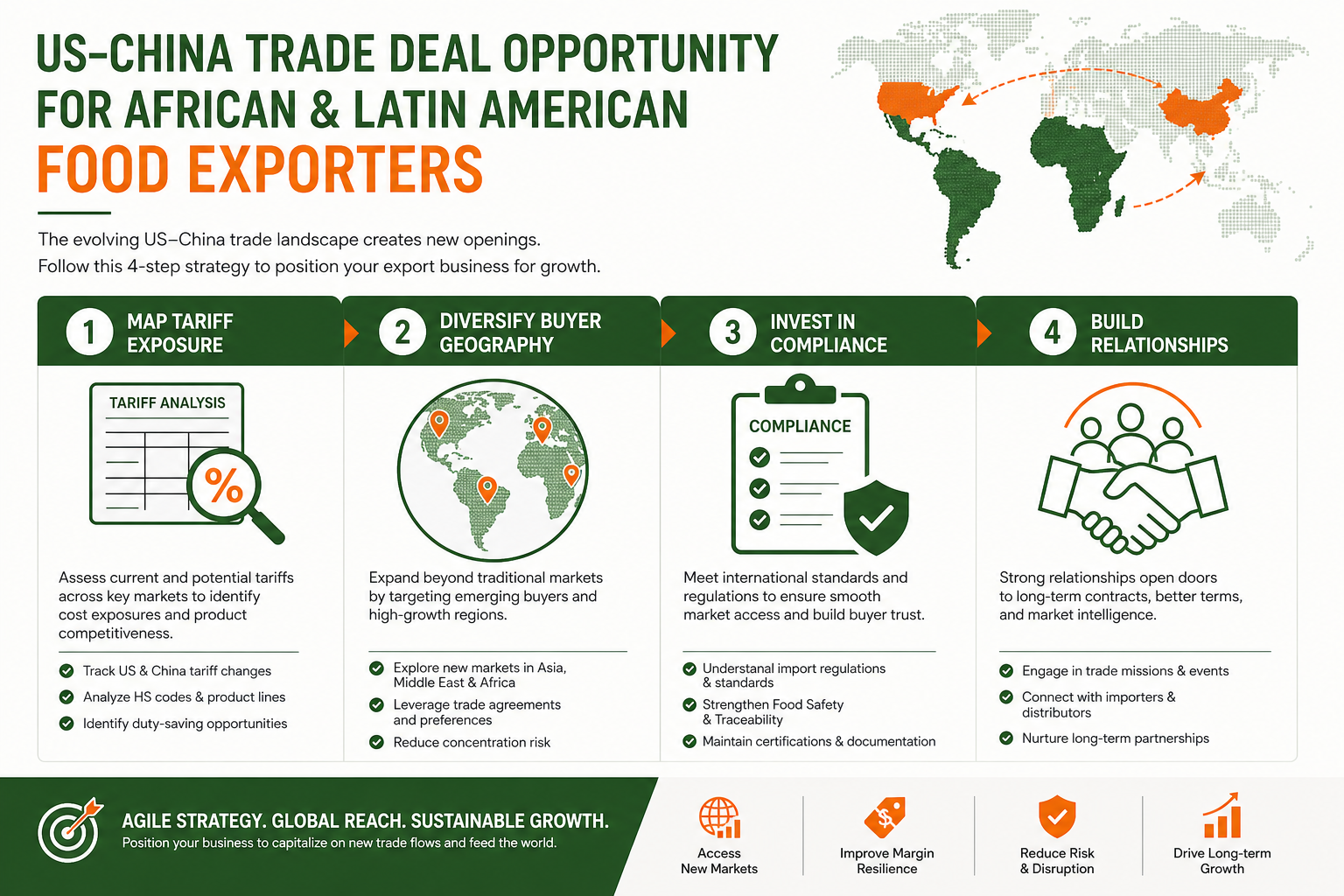
1. Map Your Tariff Exposure Across All Major Markets
The first and most important action is to map your current and potential export destinations against the tariff rates that apply to your products. This sounds basic, but the tariff landscape has shifted so dramatically in the past 18 months that many exporters are operating on outdated assumptions.
For each product you export, create a matrix that shows:
- Current tariff rate in each target market
- Tariff rate for your top three competitors in each market
- Your net price advantage or disadvantage after tariff
A product that was uncompetitive at a 15% tariff may suddenly be very competitive when your main competitor faces a 50% rate. The arithmetic has changed — recalculate it.
2. Diversify Buyer Geography — But Strategically
The standard advice to "diversify your export markets" is correct but insufficient. Diversification that spreads your limited sales and marketing resources across 10 small markets is less effective than concentrated diversification across 2-3 large, strategically selected markets.
The strategic diversification framework for 2026-2027:
- One anchor market where you have established buyer relationships and predictable volume (this might be the EU for many African exporters, or China for many Latin American exporters)
- One growth market where the tariff structure gives you a competitive advantage (the US for non-tariffed exporters, China for exporters of products not covered by the Trump-Xi deal)
- One option market where you're building relationships for the medium term (a regional market like the African Continental Free Trade Area, or a fast-growing Asian market like Vietnam or Indonesia)
3. Invest in Compliance Before You Need It
Chinese food safety standards and import regulations are not static — they are tightening, and the enforcement is becoming more rigorous. The same is true for the US (FDA import alerts and detention rates have increased) and the EU (EUDR compliance is the most significant new regulatory requirement, but not the only one).
Exporters who invest in compliance infrastructure — traceability systems, laboratory testing capacity, certification maintenance — before they pursue new market entry will move faster and face fewer setbacks than exporters who try to build compliance on the fly.
The cost of non-compliance is not just the rejected shipment — it's the damaged buyer relationship, the lost momentum, and in some cases, the blacklisting that makes future market entry far more difficult.
4. Build Relationships, Not Just Transactions
The most durable competitive advantage in food trade is not price — it's relationships. Chinese food importers, US food distributors, and EU retail buyers all prefer to work with suppliers they know and trust. The Trump-Xi deal will shift prices and volumes, but it will not shift buyer-supplier relationships that have been built over years of reliable delivery, quality consistency, and commercial integrity.
Invest in trade show attendance, buyer visits, and relationship-building activities even when the immediate ROI is hard to measure. The food trade is a relationship business that happens to involve commodities — not a commodity business that happens to involve relationships.
📊 Download the Opportunity Assessment Worksheet →
Customizable worksheet to assess how the May 2026 US-China trade deal affects your specific export products. Market access changes, tariff reductions, quota allocations, and competitive positioning analysis framework.
Free download — no email required.
Looking Ahead: Scenarios for 2027-2028
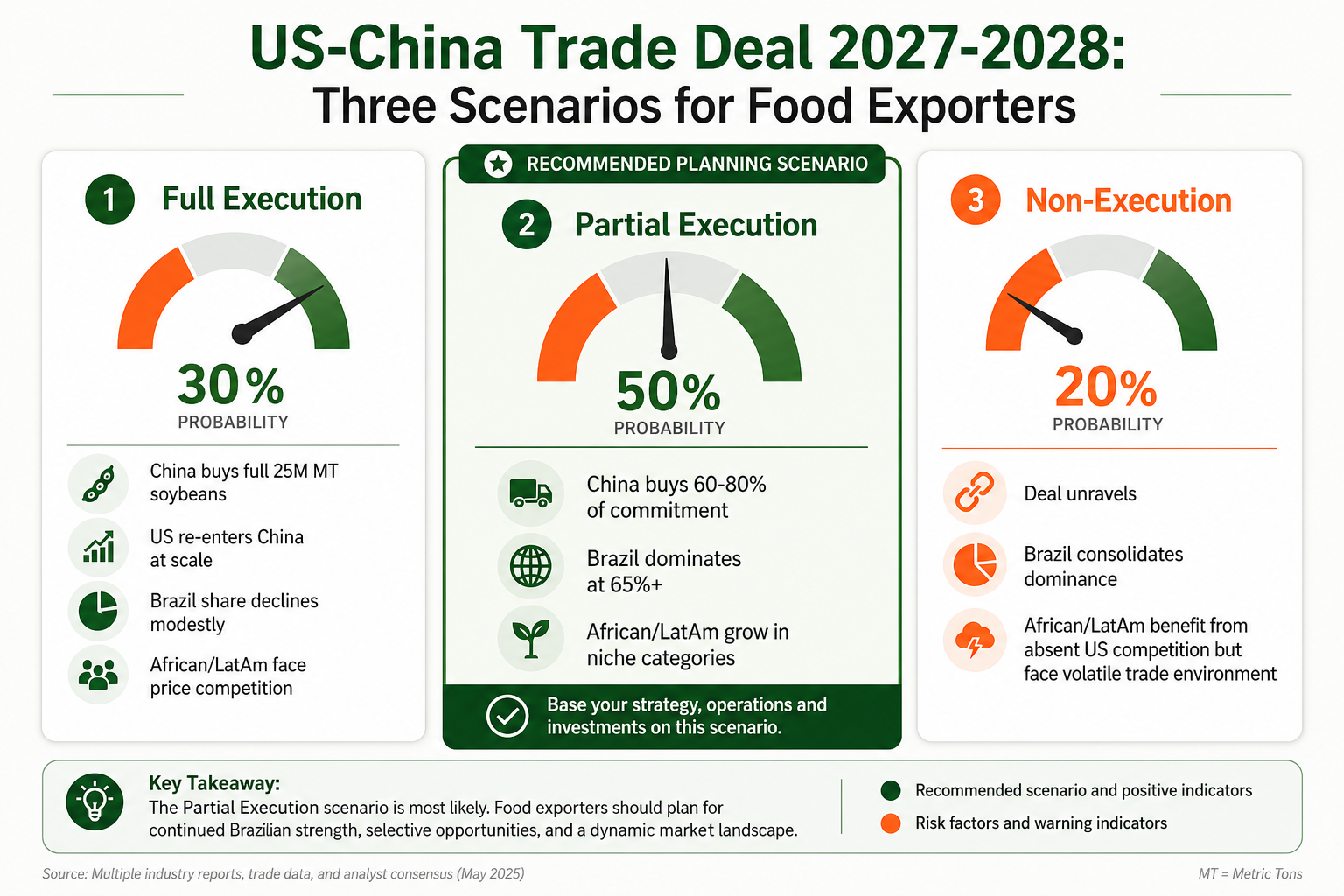 Full execution (30% probability): China fully executes the Trump-Xi soybean commitment of 25 million metric tons annually through 2028. US soybeans re-enter the Chinese market at scale. Brazilian market share declines modestly but remains above 65%. African and Latin American soybean exporters face increased price competition but benefit from the overall expansion of Chinese import demand. Other agricultural categories (beef, sorghum, processed foods) see similar dynamics.
Partial execution (50% probability): China purchases US soybeans at 60-80% of the committed volume — consistent with the historical pattern of Chinese agricultural purchase commitments. US soybeans regain some market share but not enough to fundamentally alter the Brazil-dominated sourcing structure. African and Latin American exporters continue to grow in niche and specialty categories while facing commodity price pressure from US-Brazil competition.
Non-execution / re-escalation (20% probability): The Trump-Xi deal unravels — either because of a specific trade dispute, a broader geopolitical escalation, or a change in political leadership. US-China agricultural trade reverts to disruption mode. Brazil consolidates its Chinese market dominance. African and Latin American exporters benefit from the continued absence of US competition but face a more volatile and unpredictable global trade environment.
The 50% scenario is the one to build your business plan around. The Trump-Xi deal is real enough to shift market dynamics but not so definitive that it eliminates the opportunity for alternative suppliers. The exporters who position themselves now — building relationships, investing in compliance, diversifying buyer geography — will be the ones who capture value regardless of which scenario materialises.
Jean-Marc du Plessis is a food export strategist and MBA graduate of INSEAD with 14+ years of experience in African agricultural exports. He has facilitated over $9.5M in food export transactions across 18 countries and regularly advises exporters on trade policy compliance and market entry strategy.
Ready to connect with verified international food buyers? Explore FoodExpoConnect and access 13,000+ exhibitors from major global trade shows — including Chinese, US, and European buyers actively seeking new supplier relationships.
Frequently asked questions
What did the May 2026 Trump-Xi summit agree on for agricultural trade?
How does the US-China trade deal affect African food exporters?
Which Latin American countries benefit most from the US-China trade realignment?
What food products have the greatest opportunity in the Chinese market right now?
Should I shift my export strategy toward China or the US in 2026?
Quick facts
Published: 5/17/2026
Reading time: 12 min
Pillars: Global Trade, Emerging Markets
Written by

Jean Marc Koffi
Co-authorJournalist & Export SpecialistLondon
Jean Marc Koffi is an MBA-trained trade specialist who connects African exporters to global buyers, with over $20M in contracts facilitated and expertise recognized by major trade organizations. Noted for rapid buyer network building, he is an experienced speaker and certified in trade facilitation, origin rules, and food safety.

Alocha Massamba
Co-authorFounder, Epifresh & FoodExpoConnectLondon
Alocha Massamba is the founder of Epifresh and FoodExpoConnect. He builds the technology, data and partnerships that connect African food producers and exporters to international buyers — with a focus on fresh-produce supply chains, cold-chain logistics, and the buyer-discovery platforms small and mid-size exporters need to compete with global incumbents.
Series
More in US–China Trade Reset 2026
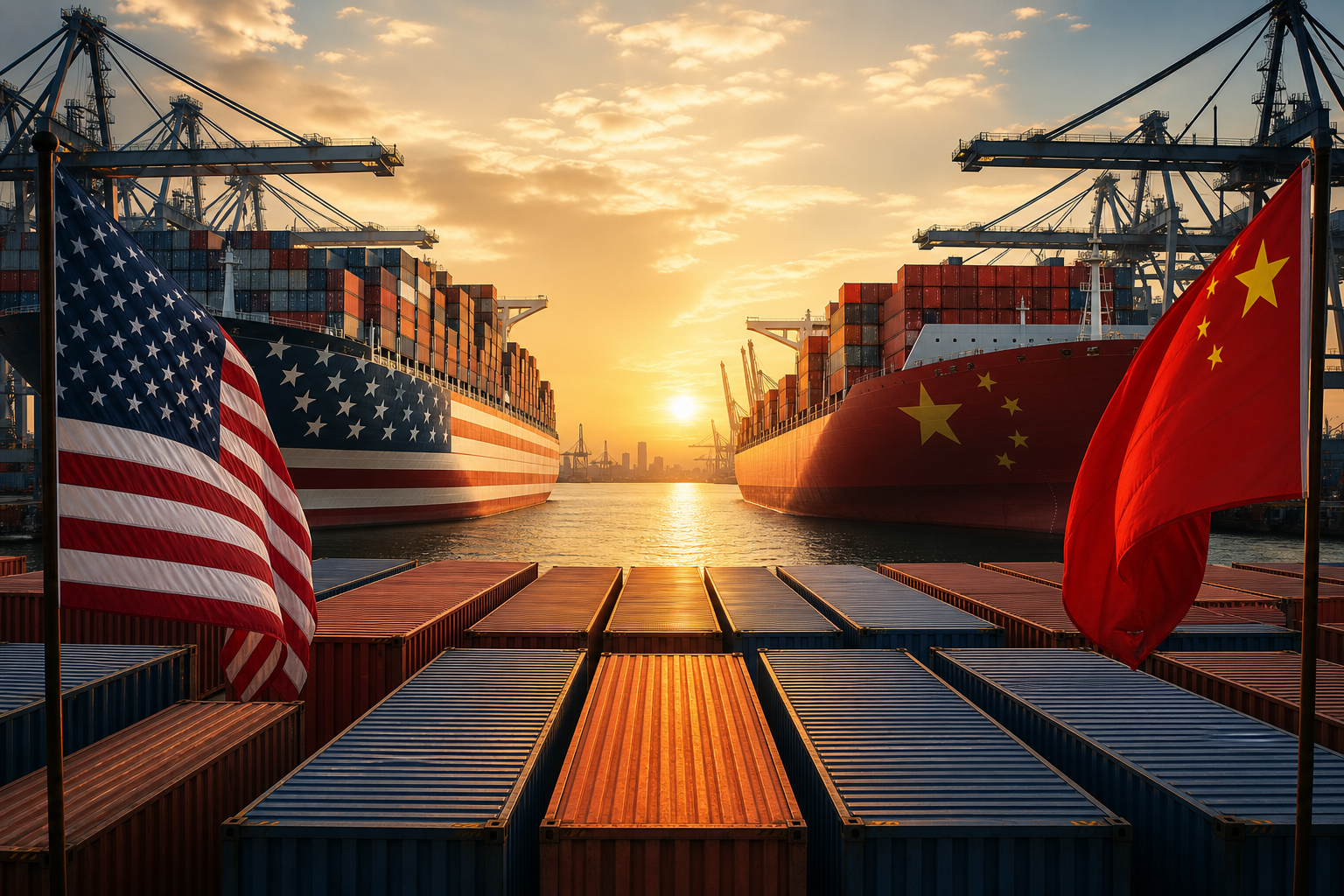
US-China Trade Reset 2026: What the Trump-Xi Tariff Deal Means for Food Exporters Worldwide
The May 2026 Trump-Xi tariff reduction framework covering $30 billion in bilateral trade is reshaping global food export flows. African and Latin American exporters stand to gain as US soybeans and beef face continued uncertainty in Chinese markets.
Global Food Trade Tariffs in 2026: How US-China-EU Trade Tensions Are Reshaping Agricultural Exports
US baseline 10% tariffs with up to 50% country-specific rates are restructuring global food trade. Brazil, Canada, and India face steep rates. Here's how food exporters can navigate the new tariff landscape.
Explore more export intelligence
Certification • Pricing Strategy • Market Access
5 Certifications Worth More Than a Price Cut in 2026
Stop competing on price. Organic, Fair Trade, Rainforest Alliance, B Corp, and SQF certifications can command 20-300% price premiums for African food exporters in 2026. Here is the ROI data for each.
Coffee Export • Market Access • EU Regulations
Coffee Export 2026: African Origins, Fair Trade Pricing & EU Market Access
Complete guide to coffee export from Ethiopia, Kenya and Rwanda — EUDR compliance, fair trade pricing, certification requirements, and how to access €12-18/kg EU buyer contracts in 2026.
Market Access • Africa Trade • Export Strategy
China Zero-Tariff Policy for African Food Exporters: Coffee Imports Surge 145.7% — How to Enter the World's Largest Market Duty-Free
China's zero-tariff policy covering 53 African countries is already producing dramatic results — coffee imports surged 145.7% in the first five months. How food exporters can access this duty-free window and bypass traditional tariff barriers.