
FoodExpoConnect Blog
SeriesUS–China Trade Reset 2026US-China Trade Reset 2026: What the Trump-Xi Tariff Deal Means for Food Exporters Worldwide
The May 2026 Trump-Xi tariff reduction framework covering $30 billion in bilateral trade is reshaping global food export flows. African and Latin American exporters stand to gain as US soybeans and beef face continued uncertainty in Chinese markets.
International Buyer Directory
Verified contact information for international food buyers in 50+ countries
Introduction
On 13 May 2026, officials in Washington and Beijing confirmed what food commodity traders had been anticipating for months: Presidents Trump and Xi Jinping will evaluate a tariff reduction framework covering $30 billion in bilateral trade. The news sent soybean futures up 4% in Chicago and triggered a flurry of renegotiations across agricultural supply chains from Mato Grosso to Mombasa.
But here's what most coverage misses: the biggest winners from this deal won't be American farmers or Chinese consumers. They'll be the food exporters in Africa, Latin America, and Southeast Asia who've spent the past eighteen months quietly building the supply chains that a fractured US-China trade relationship now demands.
What you'll learn in this analysis:
- The exact state of US-China agricultural trade as of May 2026 — what's tariffed, what isn't, and what's changing
- Which commodities are being displaced and where the market openings are
- Why African and Latin American exporters are structurally positioned to benefit
- Practical steps to position your export business for the H2 2026 trade environment
- Shipping and logistics implications of a two-speed global trade lane system
The State of Play: US-China Agricultural Trade in May 2026
To understand where the opportunities are, you need to understand how much damage has already been done.
The Trump administration's "Liberation Day" tariffs of April 2025 imposed broad supplemental duties on imports from nearly all US trading partners. China retaliated with its own tariff package targeting US agricultural exports — soybeans, beef, pork, corn, and wheat among them. By August 2025, the Trump administration had negotiated framework agreements with individual countries offering market access for US goods in exchange for lower supplemental tariffs, but China — as the principal market for US soybean exports — remained largely outside these deals.
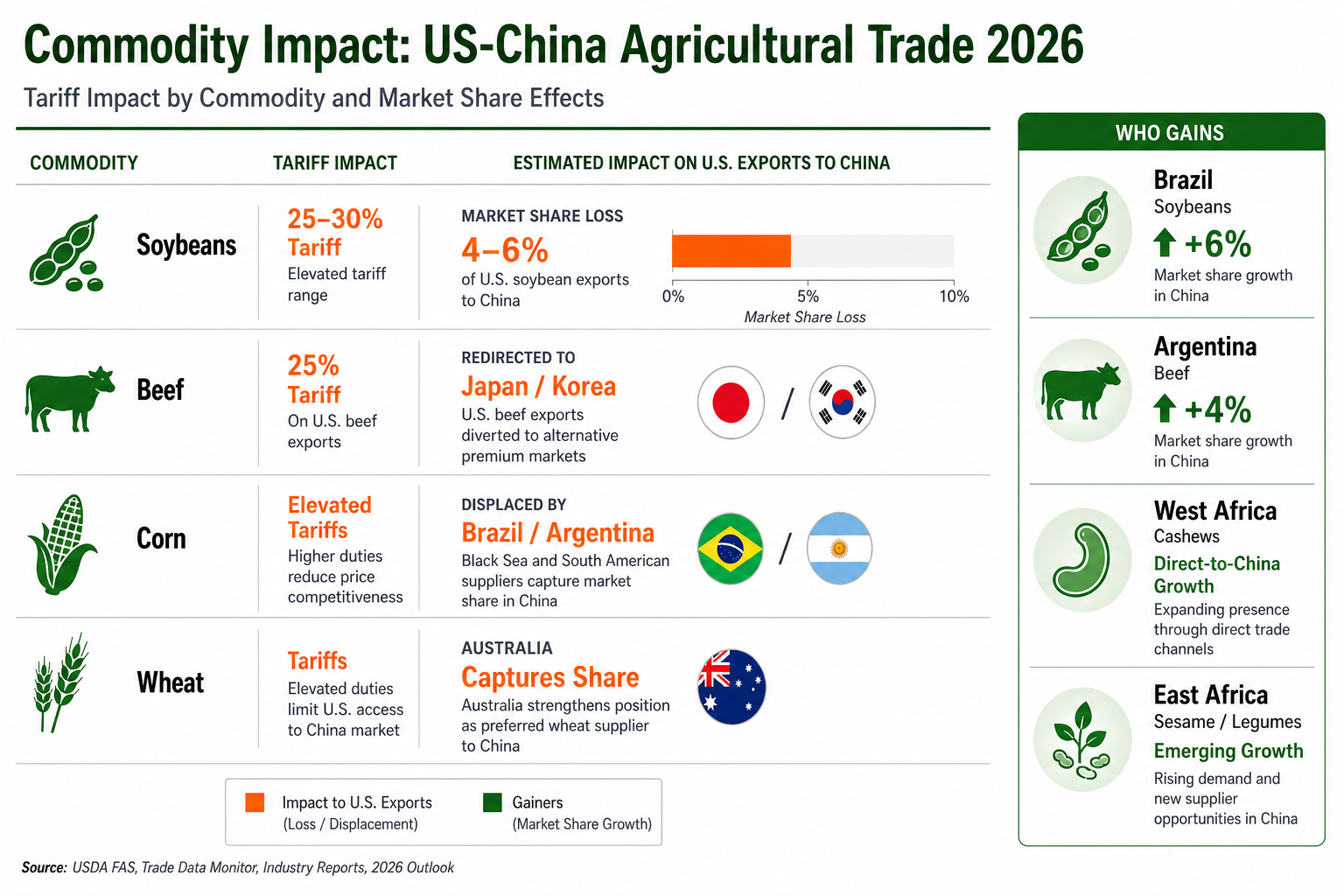
Research published in Agricultural Economics quantifies the damage: a 10% increase in retaliatory tariffs on a US agricultural export results in approximately a 1.45% to 2.14% reduction in export volumes. Applied to the 25-30% effective tariff rates US soybeans have faced in China since mid-2025, that translates to a structural loss of 4-6% of US soybean market share — market share that has flowed predominantly to Brazil, Argentina, and increasingly to African producers entering the global oilseed trade.
According to S&P Global, China actively avoided purchasing US-origin soybeans throughout the 2025-2026 marketing year, even when US prices were competitive. Chinese importers had already diversified — they'd invested in Brazilian port infrastructure, signed forward contracts with Argentine cooperatives, and begun exploratory purchases from East African sesame and legume producers. These supply chain investments aren't easily unwound.
What the May 2026 Framework Actually Does
The Trump-Xi framework being evaluated is deliberately limited:
- In scope: non-sensitive goods — beef, certain energy products, and potentially grains
- Out of scope: technology products, electronics, and anything with national security implications
- Structure: selective tariff reductions, not a comprehensive free trade agreement
- Timeline: implementation likely Q3-Q4 2026 if the framework is approved at the Beijing summit
For food exporters, the critical detail is what's not changing: China's broader agricultural import strategy has permanently diversified. Even if US soybean tariffs drop to zero tomorrow, Chinese crushers have spent two years building relationships with Brazilian and Argentine suppliers. They won't abandon those relationships for price alone.
The Substitution Effect: Where the Market Openings Are
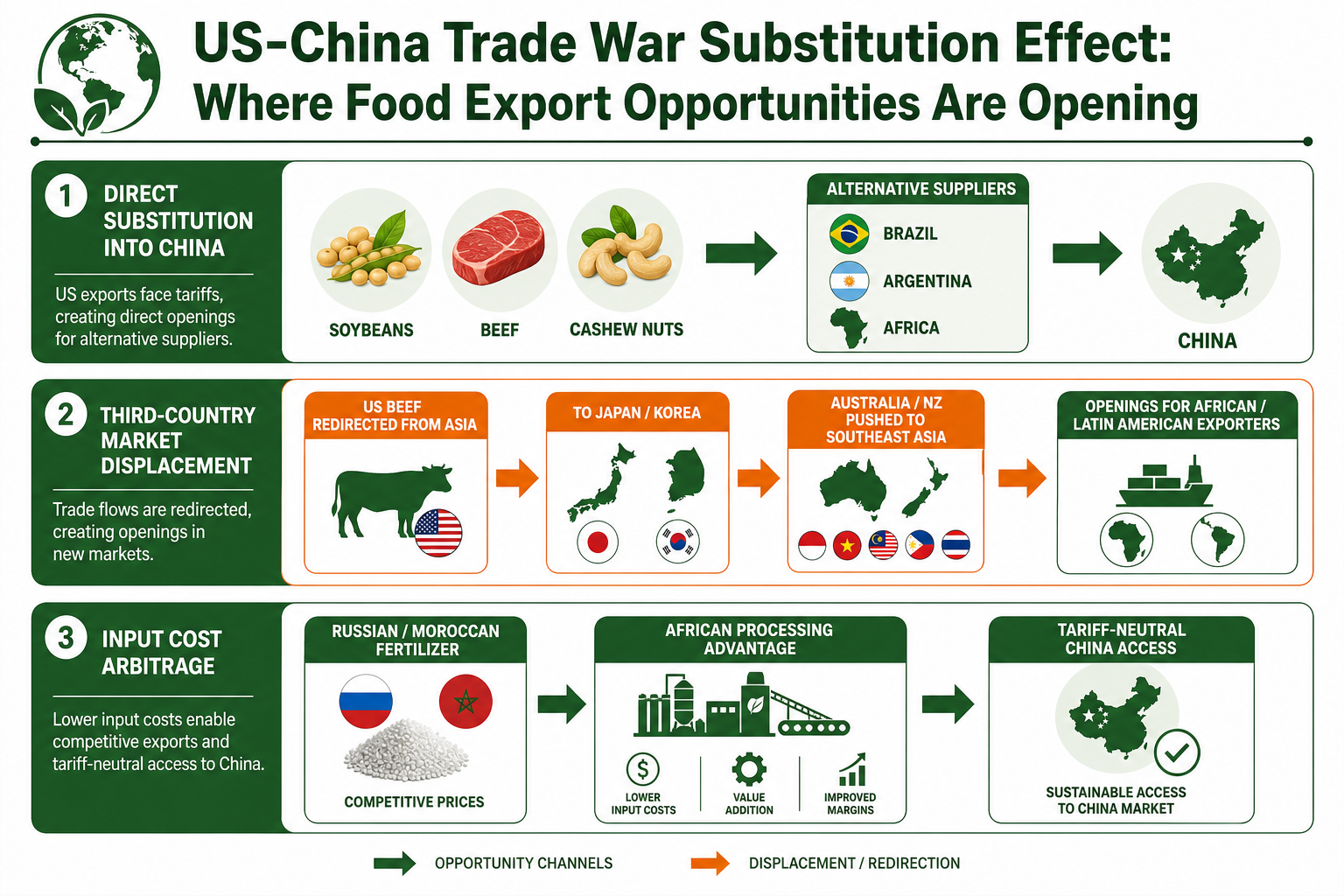 When two giants fight, the nimble players eat. The US-China trade disruption has created three categories of opportunity for non-aligned food exporters:
1. Direct Substitution Into the Chinese Market
China still needs to import food. Its domestic production can't meet demand for soybeans (crushed for animal feed and cooking oil), beef, dairy, and a growing list of specialty products — cashew nuts, cocoa, coffee, sesame seeds, and frozen seafood.
With US suppliers facing a 25-30% tariff disadvantage, Chinese importers are actively seeking alternatives:
- Soybeans: Brazil already supplies 70% of China's soybean imports. East African producers (Ethiopia, Tanzania, Uganda) are emerging as niche suppliers of non-GMO, organic soybeans commanding premium prices for Japan and South Korea — markets that are themselves diversifying away from Chinese intermediaries.
- Beef: Argentine and Uruguayan grass-fed beef has captured shelf space in Chinese premium retail that US grain-fed beef previously occupied. African beef producers face sanitary and phytosanitary barriers but the Namibia-Beijing beef protocol (signed 2024) shows the pathway exists.
- Cashew nuts: Vietnam processes the majority of global cashew exports, but raw cashew nuts from West Africa (Côte d'Ivoire, Ghana, Nigeria, Benin) feed that processing industry. Chinese buyers are now contracting directly with West African producers, bypassing Vietnamese intermediaries — a direct result of supply chain diversification strategies accelerated by trade uncertainty.
2. Third-Country Market Displacement
The less obvious but potentially larger opportunity: when US agricultural products face restricted access to China, they flood alternative markets — and drive out incumbent suppliers who then need new homes for their product.
US beef that can't enter China gets redirected to Japan, South Korea, and the Middle East. Australian and New Zealand beef that previously dominated those markets gets displaced to Southeast Asia. Brazilian poultry that loses Middle Eastern market share to US exporters gets redirected to... and the cascade continues until it reaches the price point where African and South Asian markets can absorb the volume.
For an African or Latin American food exporter, the playbook is:
- Identify which premium markets are being flooded with redirected US product
- Target the mid-tier markets those premium suppliers are vacating
- Build relationships now with buyers who are actively diversifying their supplier base
3. Input Cost Arbitrage
The trade war has also created unusual spreads in agricultural input costs. US fertiliser exports to China have declined, increasing fertiliser costs for Chinese farmers and making Chinese agricultural products marginally less competitive. Simultaneously, Russian and Moroccan fertiliser (unaffected by US-China tariffs) has become more price-competitive in African and Latin American markets.
An African cashew or cocoa exporter buying Russian potash at competitive prices, processing in a tariff-neutral jurisdiction, and selling into a Chinese market hungry for non-US origin product is operating with a structural cost advantage that didn't exist in 2024.
The Shipping Dimension: A Two-Speed Global Trade Lane System
One of the most consequential but under-reported dynamics in Q2 2026 is the divergence in container shipping costs between trade lanes.
The Iran conflict has disrupted Middle Eastern shipping lanes, driving spot rates from Asia to Europe up approximately 40% since late February 2026, according to Xeneta data. Carriers are implementing emergency bunker surcharges and increasing blank sailings on Asia-Europe routes to manage capacity and support rates.
Simultaneously, the Asia-North America trade lane is experiencing a buyer's market. Massive vessel overcapacity — newbuilds ordered during the 2021-2022 shipping boom are now entering service — has driven transpacific spot rates down over 70% from their 2022 peak. According to DocShipper's 2026 Freight Rate Forecast, this overcapacity is structural: too many vessels, not enough cargo demand on the major east-west routes.
What does this mean for food exporters?
- Exporting from Asia to Europe: Prepare for elevated rates through at least Q3 2026. The Iran disruption isn't resolving quickly, and carriers have demonstrated they'll use blank sailings to defend rate floors.
- Exporting from Africa or Latin America to Asia: This is the sweet spot. These south-south and south-east trade lanes are serviced by smaller vessels unaffected by the Asia-Europe disruption and the transpacific overcapacity glut. Rates are stable and competitive.
- Exporting from Africa to Europe: Near-sea shipping (West Africa to Mediterranean, East Africa to Suez) is cost-competitive and relatively insulated from the deep-sea disruptions. This is an under-exploited corridor for African food exporters.
The practical implication: if you're an African food exporter, your shipping cost advantage over a US competitor trying to reach the same Asian buyer has widened in 2026. Use it.
What to Do Now: Positioning for H2 2026
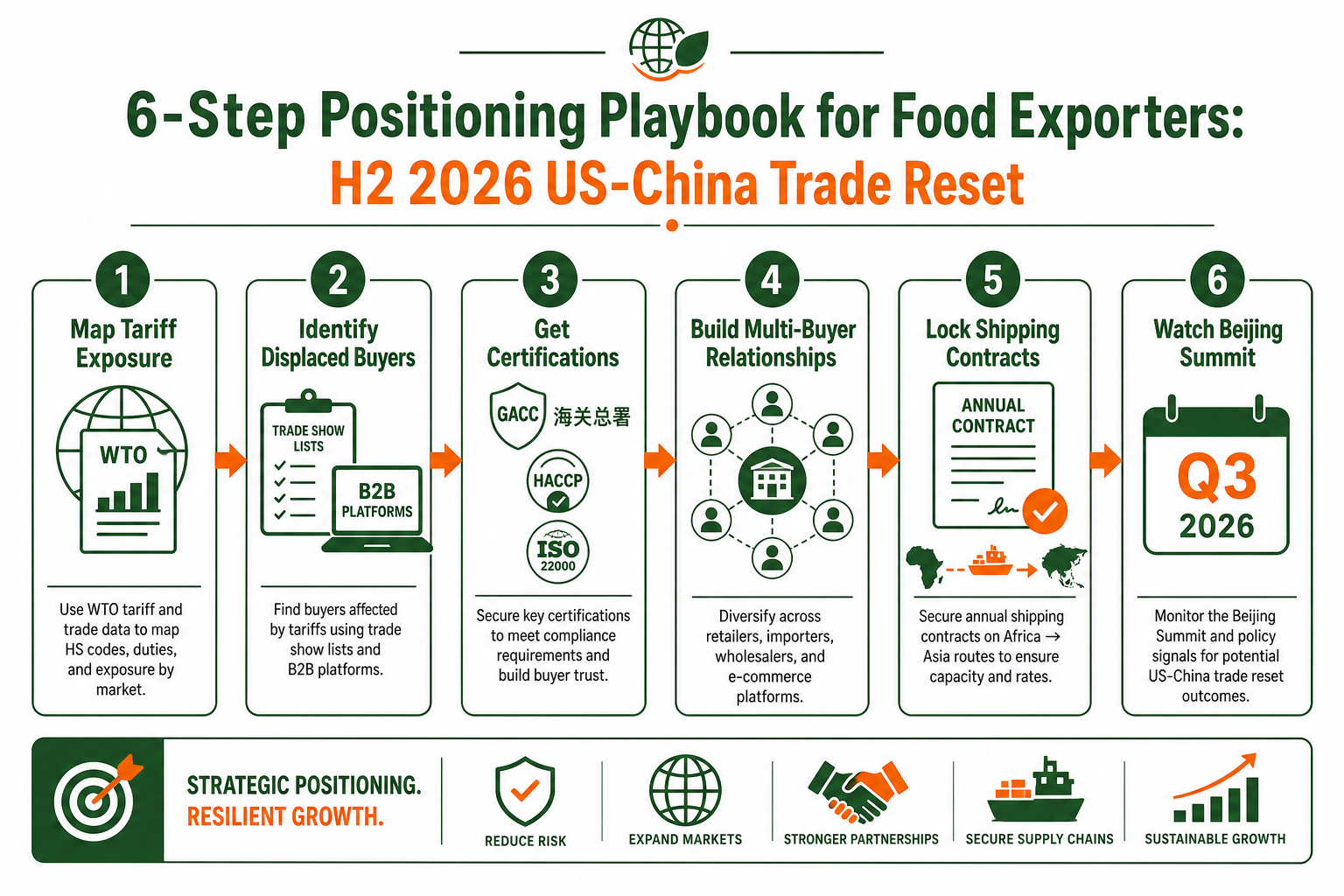
The window for positioning is open but closing. Here's the six-step playbook:
1. Map Your Commodity's Tariff Exposure
Go to the WTO Tariff Data portal and pull the current bound and applied tariff rates for your product in China, the EU, and your target markets. If you're exporting a commodity where the US is a major supplier facing elevated Chinese tariffs, you have a window. Document the exact tariff differential — buyers respond to concrete numbers, not general narratives.
2. Identify Displaced Buyers
Use trade show attendee lists (SIAL China 2026 runs 19-21 May in Shanghai — the lists are public), B2B platforms (Alibaba.com, Global Sources, FoodExpoConnect's own exhibitor directory), and import-export databases (Panjiva, ImportGenius) to identify Chinese importers who were previously buying from US suppliers and are now actively seeking alternatives.
3. Get Your Certifications in Order
Chinese buyers operating at scale require GACC (General Administration of Customs of China) registration for food exporters. This process takes 3-6 months. Start now. Simultaneously, ensure your HACCP, ISO 22000, and any product-specific certifications (organic, halal, non-GMO) are current. In a diversified supplier environment, the buyer with multiple certified options will always choose the one that requires zero additional compliance work.
4. Build Multi-Buyer Relationships
Don't put all your volume with one Chinese buyer. The Trump-Xi framework deal could reduce tariffs faster than expected, making US products competitive again in specific categories. Spread your buyer relationships across Chinese importers, regional processors (Vietnam, Thailand, Malaysia), and direct-to-retail channels in the Middle East and Europe.
5. Lock in Shipping Contracts Now
If you're shipping from Africa or Latin America to Asia, negotiate annual or semi-annual contracts with forwarders now while rates are stable. The Iran disruption could spread, drawing more vessels into longer Cape of Good Hope routings and tightening capacity on south-south lanes. A fixed-rate contract signed in Q2 2026 is cheap insurance.
6. Watch the Trump-Xi Beijing Summit
The summit date hasn't been confirmed as of mid-May 2026, but the framework evaluation suggests it'll happen in Q3. Whatever is announced will move agricultural commodity prices. Position your contracts to allow flexibility — include price adjustment clauses tied to the Shanghai Containerised Freight Index or relevant commodity benchmarks.
📋 Get the Tariff Impact Assessment Template →
Assess how US-China trade reset tariffs affect your specific product categories. Customizable template with the latest duty rates, exemption categories, and timeline projections.
Free download — no email required.
The Bigger Picture: Structural, Not Cyclical
The most important thing to understand about the US-China trade disruption is that it's structural, not cyclical. Even if the Trump-Xi framework deal eliminates all agricultural tariffs tomorrow, the supply chain investments made during the disruption period — the Brazilian port infrastructure, the Chinese buyer relationships with Argentine cooperatives, the African quality certification programmes — don't disappear.
According to the American Enterprise Institute's year-after assessment of the Liberation Day tariffs, the effects on US agricultural exports are lasting. Consumer backlash against US products in some importing countries (notably Canada) compounds the tariff effects. And the retaliatory tariff structure has proven "sticky" — once buyers invest in alternative supply chains, they require more than tariff parity to switch back.
For African, Latin American, and Southeast Asian food exporters, this is the defining trade opportunity of the decade. The question isn't whether the market opening exists. It's whether you can certify, contract, ship, and deliver before the window narrows.
Last updated 17 May 2026. Shipping rate data from Xeneta and DocShipper. Trade policy analysis from S&P Global, AEI, and Agricultural Economics.
Frequently asked questions
What is the Trump-Xi tariff deal announced in May 2026?
How does the US-China trade war affect food exporters outside these two countries?
Which food commodities are most affected by US-China tariffs?
Should African food exporters target the Chinese market right now?
What's the outlook for global food trade in H2 2026 given these trade tensions?
Quick facts
Published: 5/17/2026
Reading time: 16 min
Pillars: Global Markets, Trade Policy
Written by

Jean Marc Koffi
Co-authorJournalist & Export SpecialistLondon
Jean Marc Koffi is an MBA-trained trade specialist who connects African exporters to global buyers, with over $20M in contracts facilitated and expertise recognized by major trade organizations. Noted for rapid buyer network building, he is an experienced speaker and certified in trade facilitation, origin rules, and food safety.

Alocha Massamba
Co-authorFounder, Epifresh & FoodExpoConnectLondon
Alocha Massamba is the founder of Epifresh and FoodExpoConnect. He builds the technology, data and partnerships that connect African food producers and exporters to international buyers — with a focus on fresh-produce supply chains, cold-chain logistics, and the buyer-discovery platforms small and mid-size exporters need to compete with global incumbents.
Series
More in US–China Trade Reset 2026
US-China Trade Deal May 2026: What the Trump-Xi Summit Means for African and Latin American Food Exporters
The Trump-Xi Beijing summit produced a commitment for China to buy 25 million metric tons of US soybeans annually through 2028 — and 'double-digit billions' in broader agricultural purchases. Here's what the reconfigured US-China food corridor means for exporters in Africa and Latin America.
Global Food Trade Tariffs in 2026: How US-China-EU Trade Tensions Are Reshaping Agricultural Exports
US baseline 10% tariffs with up to 50% country-specific rates are restructuring global food trade. Brazil, Canada, and India face steep rates. Here's how food exporters can navigate the new tariff landscape.
Explore more export intelligence
Certification • Pricing Strategy • Market Access
5 Certifications Worth More Than a Price Cut in 2026
Stop competing on price. Organic, Fair Trade, Rainforest Alliance, B Corp, and SQF certifications can command 20-300% price premiums for African food exporters in 2026. Here is the ROI data for each.
Coffee Export • Market Access • EU Regulations
Coffee Export 2026: African Origins, Fair Trade Pricing & EU Market Access
Complete guide to coffee export from Ethiopia, Kenya and Rwanda — EUDR compliance, fair trade pricing, certification requirements, and how to access €12-18/kg EU buyer contracts in 2026.
Market Access • Africa Trade • Export Strategy
China Zero-Tariff Policy for African Food Exporters: Coffee Imports Surge 145.7% — How to Enter the World's Largest Market Duty-Free
China's zero-tariff policy covering 53 African countries is already producing dramatic results — coffee imports surged 145.7% in the first five months. How food exporters can access this duty-free window and bypass traditional tariff barriers.