
FoodExpoConnect Blog
The Fertilizer Supply Chain Crisis: What Food Exporters Must Know About the Hormuz Disruption and China's Sulfuric Acid Export Restrictions
China's May 2026 sulfuric acid export restrictions and Hormuz Strait disruptions are creating a global fertilizer shortage. Here's how food exporters can navigate the knock-on effects on crop yields, pricing, and supply contracts.
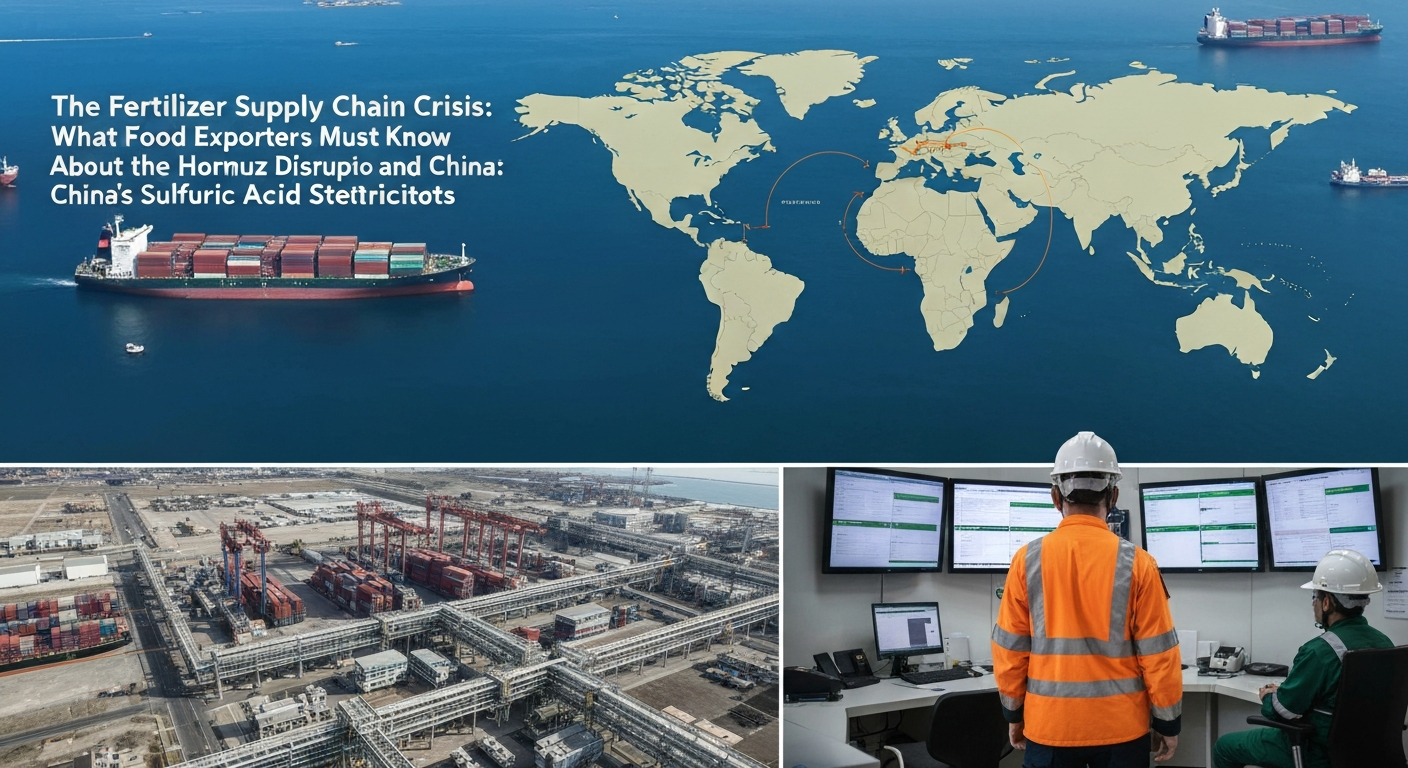
While shipping disruptions dominate headlines, a quieter crisis is unfolding in global agriculture that will shape food export prices and availability for the next 18-24 months: the fertilizer supply chain is under simultaneous pressure from multiple directions, and the effects are only beginning to reach consumer markets.
The Double Shock: China and Hormuz
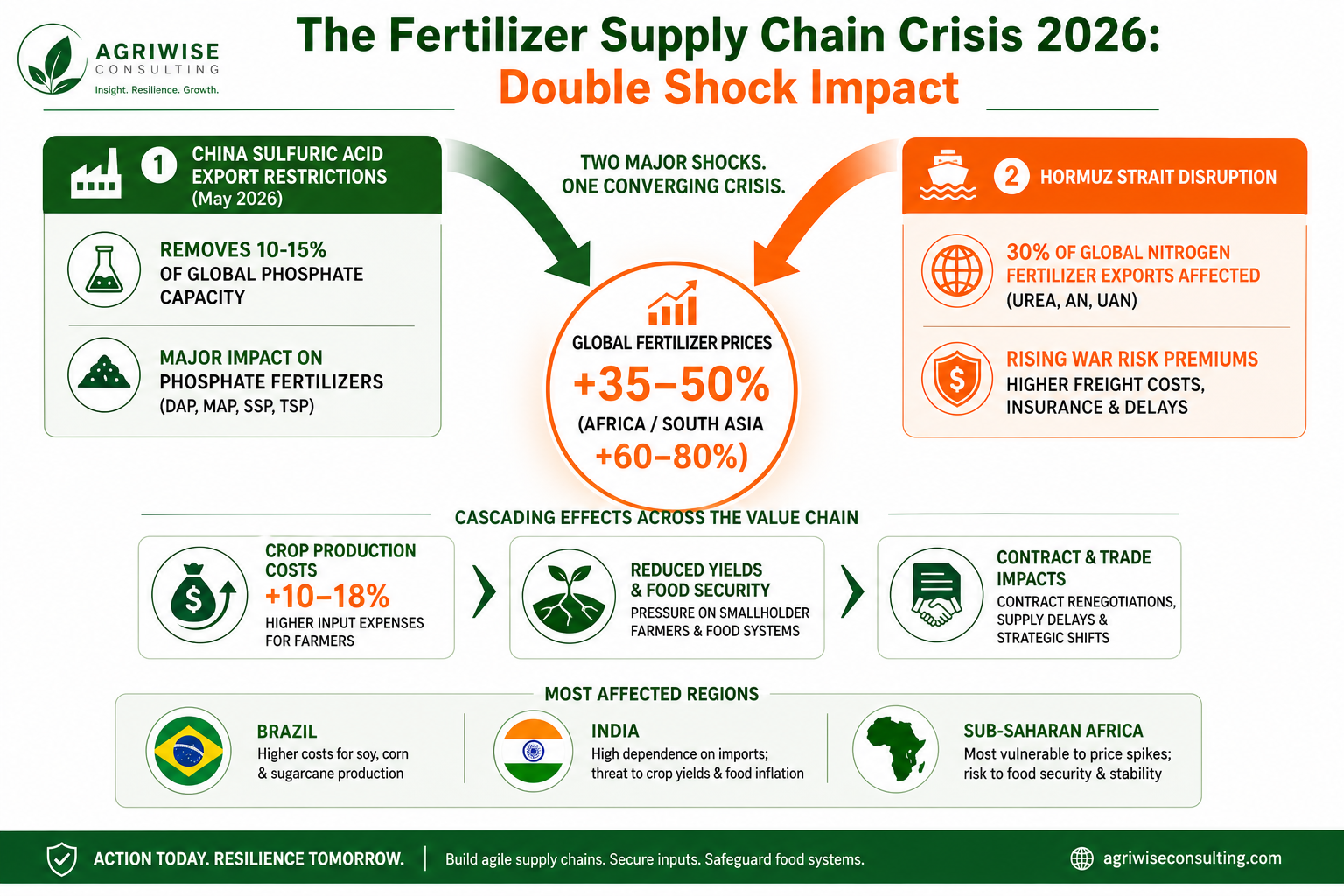
Two events in early 2026 have created a compound crisis for global fertilizer markets. China — the world's largest producer of phosphate fertilizers — restricted sulfuric acid exports starting May 2026. Sulfuric acid is a critical input for phosphate fertilizer production, and the restriction removes an estimated 10-15% of global phosphate production capacity from the market.
Simultaneously, the Strait of Hormuz disruption — the same geopolitical dynamic driving Red Sea shipping avoidance — has increased transit costs and insurance premiums for Middle Eastern fertilizer exports. The Persian Gulf region produces roughly 30% of the world's nitrogen fertilizers (urea, ammonia) and a significant share of phosphate rock. Every vessel carrying fertilizer from Saudi Arabia, Qatar, UAE, or Oman now faces elevated war risk premiums and, in some cases, extended routing.
The combined effect: global fertilizer prices are up 35-50% from pre-crisis levels, with some regional markets in Africa and South Asia seeing increases of 60-80% due to additional shipping premiums.
The Math: How Fertilizer Costs Flow Into Food Export Prices
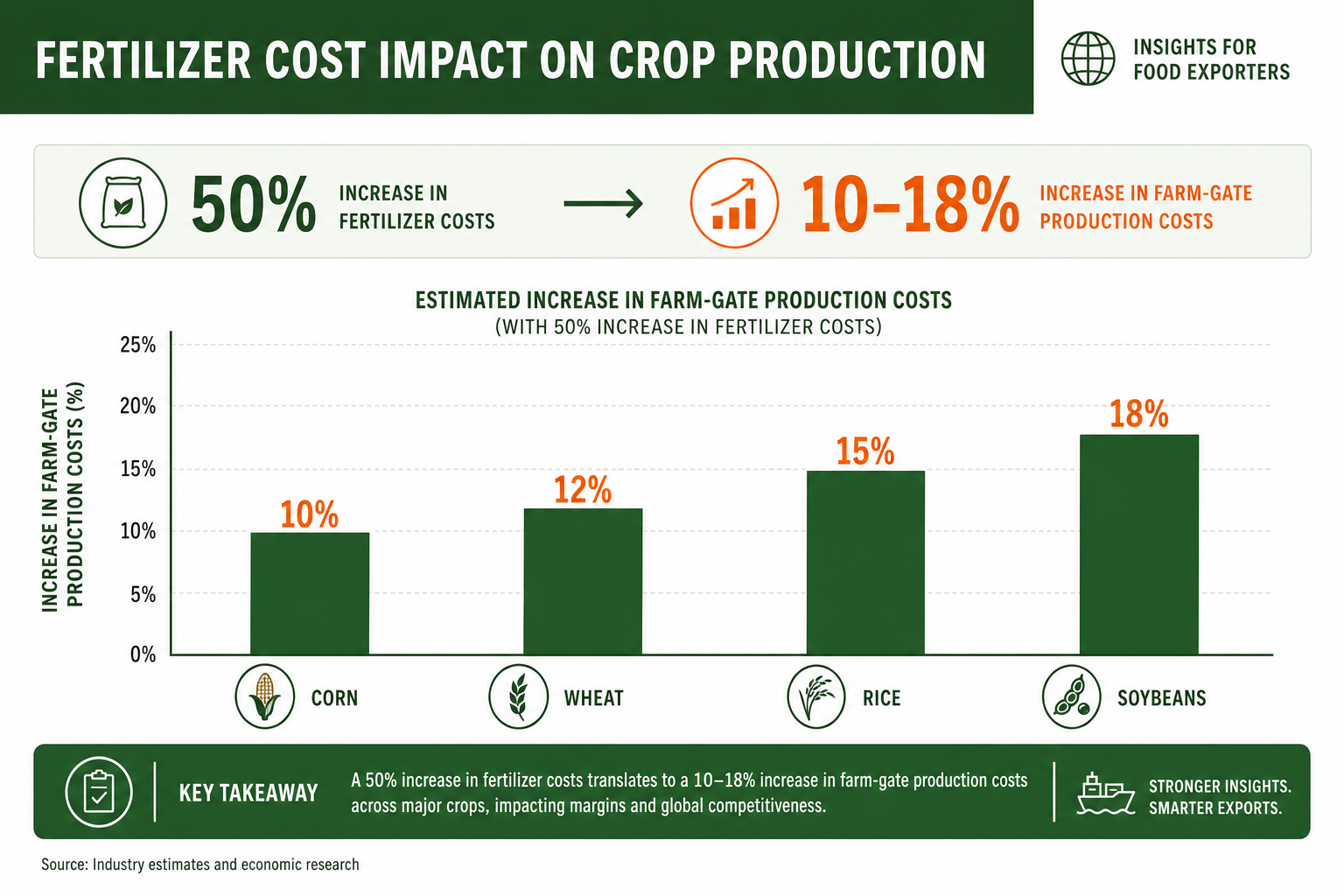
Fertilizer typically represents 20-35% of total production costs for grain crops (corn, wheat, rice) and 15-25% for oilseeds (soybeans, canola). A 50% increase in fertilizer costs therefore translates to a 10-18% increase in farm-gate production costs for these crops.
For food exporters, this means:
- Higher raw material costs for processed food products using grain or oilseed inputs
- Reduced availability as farmers reduce planted area or fertiliser application rates in response to higher costs
- Contract renegotiation pressure as buyers resist price increases and exporters face margin compression
The countries most exposed — Brazil (imports ~85% of fertilizer needs), India (world's largest fertilizer importer by volume), and Sub-Saharan African nations (already facing high shipping costs from Red Sea disruption) — are also among the world's most important agricultural exporters.
Brazil: The 85% Import Dependency
Brazil is an agricultural superpower — the world's largest exporter of soybeans, coffee, sugar, orange juice, and beef. But it imports approximately 85% of its fertilizer needs, primarily from Russia, China, and the Middle East. Every one of those supply routes is disrupted.
The Brazilian government has been scrambling to diversify fertilizer sourcing, signing agreements with Canada, Morocco, and Jordan. But these new supply relationships take years to develop into reliable volumes, and the 2026-2027 growing season will be planted with existing supply constraints.
For food importers who rely on Brazilian soybeans, coffee, or sugar, the implication is clear: expect higher prices and expect them to persist. Brazilian farmers are sophisticated operators who will reduce fertiliser application where economically rational, but reduced application means reduced yields, and reduced global supply means higher prices for everyone.
The Regenerative Alternative
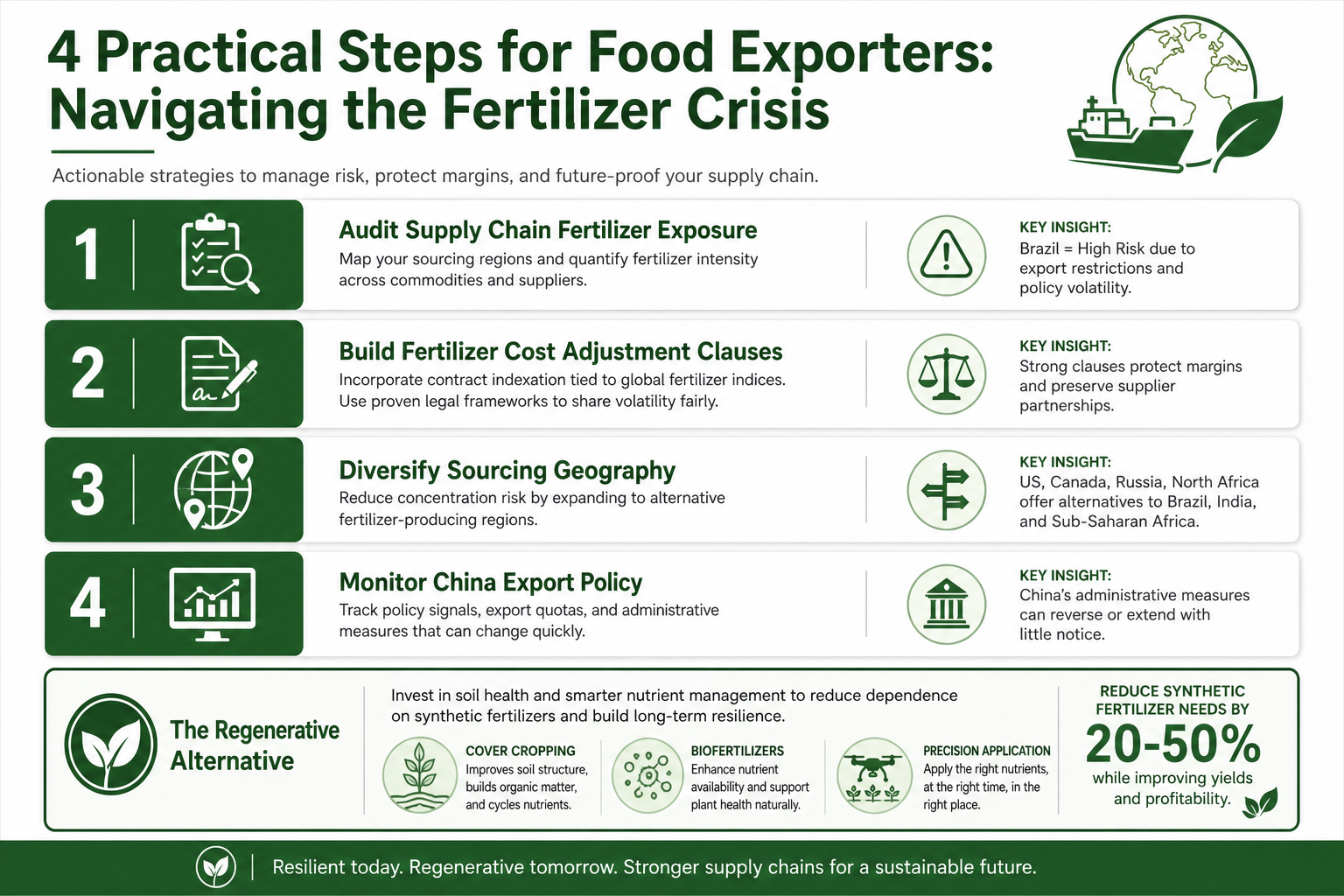
One of the more interesting developments to emerge from the fertilizer crisis is accelerated adoption of regenerative agriculture practices. Cover cropping, crop rotation, composting, biofertilizers, and precision application technology can reduce synthetic fertilizer requirements by 20-50% — but typically with a 1-3 year transition period during which yields may decline before the soil biology recovers.
The EU's Farm to Fork strategy explicitly targets a 20% reduction in synthetic fertilizer use by 2030, and several national governments (France, Germany, Netherlands) are offering transition subsidies to farmers who adopt regenerative practices. For food exporters supplying the European market, regenerative production is becoming a competitive differentiator — not just for sustainability marketing, but for supply reliability when synthetic fertilizer is scarce or expensive.
Several African agricultural development programmes — particularly in Kenya, Ethiopia, and Rwanda — are promoting biofertilizer and composting programmes specifically as a response to import dependency. These programmes are still small-scale, but they represent an important strategic direction for regions that cannot afford to be at the mercy of global fertiliser price swings.
The Food Security Dimension
The Reddit communities tracking this — particularly r/collapse, r/energy, and r/climate — are documenting a food security situation that has deteriorated faster than most institutional forecasts predicted. A UK government report published in early 2026 identifies drought, soil degradation, biodiversity loss, and trade disruption as converging threats to the global food system.
The UN's latest figures: 318 million people across 68 countries face crisis-level hunger, more than double the 2019 figure. Fertilizer shortages are a direct contributor — when farmers in developing countries cannot afford fertiliser, crop yields decline, food prices rise, and the most vulnerable populations are pushed into hunger.
For food exporters, this is not an abstract humanitarian concern. Markets in which 318 million people cannot afford food are markets in which food businesses cannot operate. Stability of the global food system is a business requirement, not a charitable cause.
📋 Get the 90-Day Fertilizer Action Plan →
90-day action plan covering fertilizer sourcing alternatives, cost mitigation strategies, and pass-through contract clauses. Includes country-specific guidance for African producers.
Free download — no email required.
Practical Recommendations for Food Exporters
Audit your supply chain's fertiliser exposure. If you export grains, oilseeds, sugar, coffee, or processed foods with significant agricultural inputs, map the fertiliser dependency of your sourcing regions. Brazil-exposed supply chains face the most risk; EU and North American supply chains face less but are not immune.
Build fertiliser cost adjustment clauses into contracts. Standard agricultural supply contracts often include force majeure or price adjustment provisions, but fertiliser-specific cost escalation is rarely addressed explicitly. Work with your legal team to build fertiliser price indexation into long-term supply agreements.
Diversify sourcing geography. If your primary supply comes from fertiliser-import-dependent regions (Brazil, India, Sub-Saharan Africa), develop secondary supply relationships in regions with domestic fertiliser production (US, Canada, Russia, North Africa). Diversification adds cost in the short term but provides insurance against supply disruption.
Engage with regenerative transition programmes. Even if you're not directly involved in agricultural production, understanding the regenerative transition timeline for your sourcing regions will help you forecast supply availability and pricing over the 2026-2028 period.
Monitor China's export policy closely. The sulfuric acid restriction is an administrative measure that could be reversed — or extended — with little notice. Chinese export policy for fertiliser inputs has become increasingly unpredictable, and any exporter with significant China-sourced agricultural inputs needs a standing monitoring process.
Jean-Marc du Plessis is a food export strategist with 14+ years of experience in African agricultural exports and global commodity supply chains. He holds an MBA from INSEAD and advises food exporters on supply chain risk management and market entry strategy.
Frequently asked questions
Why are fertilizer prices rising in 2026?
How does the fertilizer crisis affect food export prices?
Which food-exporting countries are most affected?
Are there alternatives to traditional chemical fertilizers?
How long will the fertilizer supply disruption last?
Quick facts
Published: 5/8/2026
Reading time: 10 min
Pillars: Global Trade, Agriculture
Written by

Jean Marc Koffi
Co-authorJournalist & Export SpecialistLondon
Jean Marc Koffi is an MBA-trained trade specialist who connects African exporters to global buyers, with over $20M in contracts facilitated and expertise recognized by major trade organizations. Noted for rapid buyer network building, he is an experienced speaker and certified in trade facilitation, origin rules, and food safety.

Alocha Massamba
Co-authorFounder, Epifresh & FoodExpoConnectLondon
Alocha Massamba is the founder of Epifresh and FoodExpoConnect. He builds the technology, data and partnerships that connect African food producers and exporters to international buyers — with a focus on fresh-produce supply chains, cold-chain logistics, and the buyer-discovery platforms small and mid-size exporters need to compete with global incumbents.
Explore more export intelligence
Certification • Pricing Strategy • Market Access
5 Certifications Worth More Than a Price Cut in 2026
Stop competing on price. Organic, Fair Trade, Rainforest Alliance, B Corp, and SQF certifications can command 20-300% price premiums for African food exporters in 2026. Here is the ROI data for each.
Coffee Export • Market Access • EU Regulations
Coffee Export 2026: African Origins, Fair Trade Pricing & EU Market Access
Complete guide to coffee export from Ethiopia, Kenya and Rwanda — EUDR compliance, fair trade pricing, certification requirements, and how to access €12-18/kg EU buyer contracts in 2026.
Market Access • Africa Trade • Export Strategy
China Zero-Tariff Policy for African Food Exporters: Coffee Imports Surge 145.7% — How to Enter the World's Largest Market Duty-Free
China's zero-tariff policy covering 53 African countries is already producing dramatic results — coffee imports surged 145.7% in the first five months. How food exporters can access this duty-free window and bypass traditional tariff barriers.